

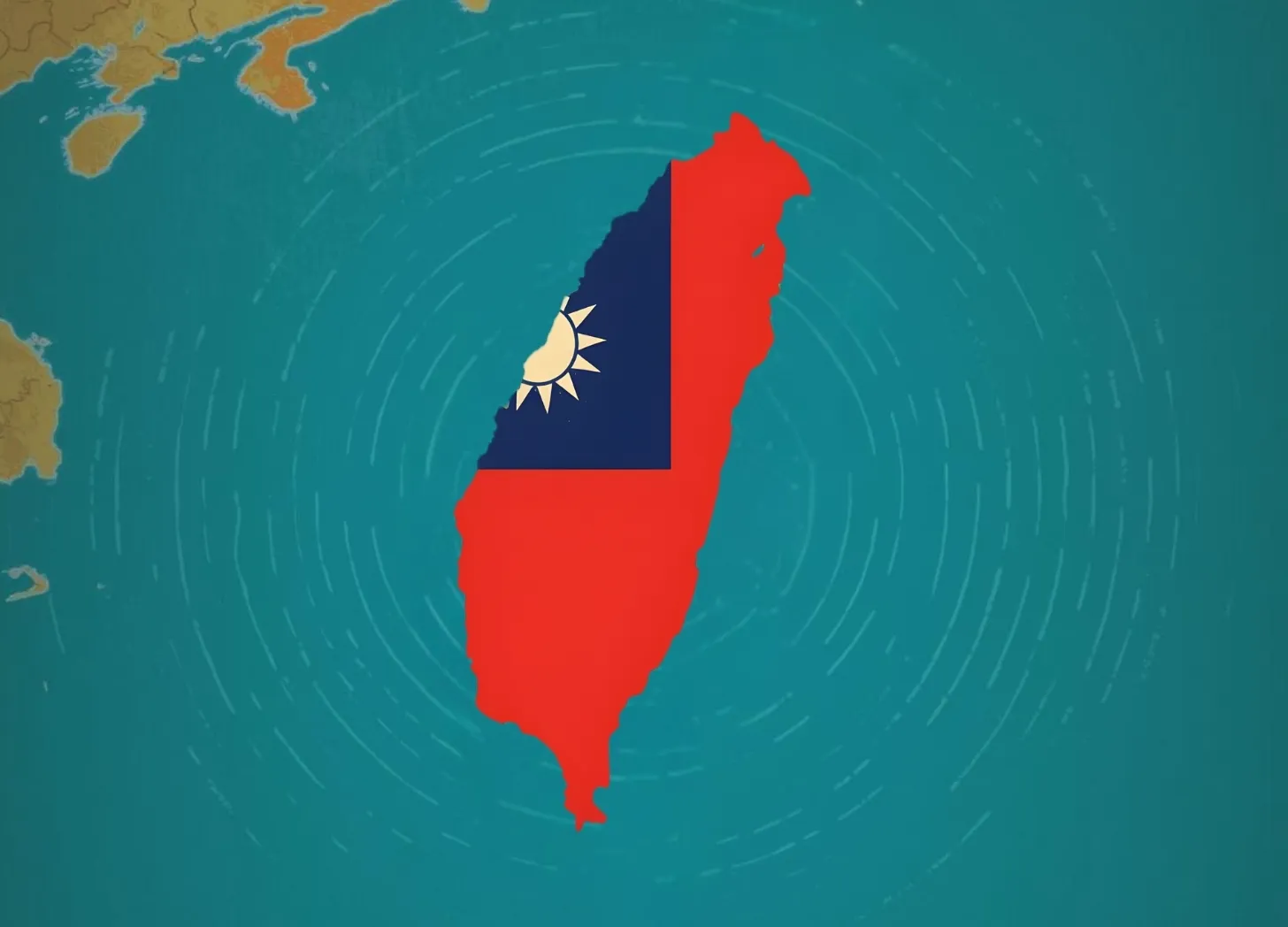
On 29-30 December 2025, China’s PLA Eastern Theater Command conducted “Justice Mission 2025,” a large-scale exercise encircling Taiwan with air, naval, rocket, and coast guard forces across seven zones. Triggered by a record $11.1 billion US arms package approved days earlier including HIMARS, ATACMS, and howitzers Beijing linked the drills to warnings against “Taiwan independence” and external interference. Taiwan reported 130 aircraft crossings, live-fire rockets near its waters, and blockade simulations targeting key ports, amid disrupted air/sea traffic. The Pentagon views this within PLA’s 2027 readiness trajectory.
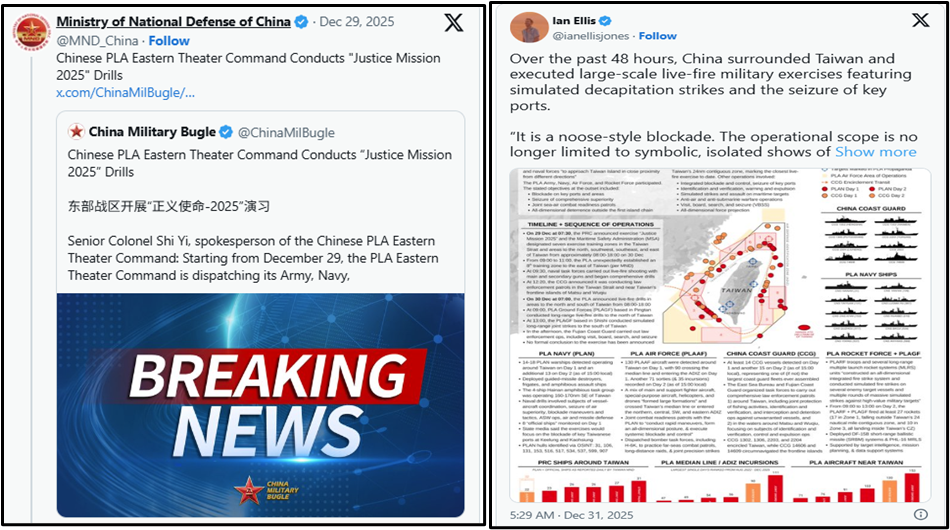
According to the Global Taiwan, on 29–30 December 2025, the PLA Eastern Theater Command launched “Justice Mission 2025,” a large‑scale joint exercise encircling Taiwan with air, naval, rocket and coast guard forces. Seven danger zones were declared around the island, effectively surrounding Taiwan and overlapping with key approaches to its major ports.
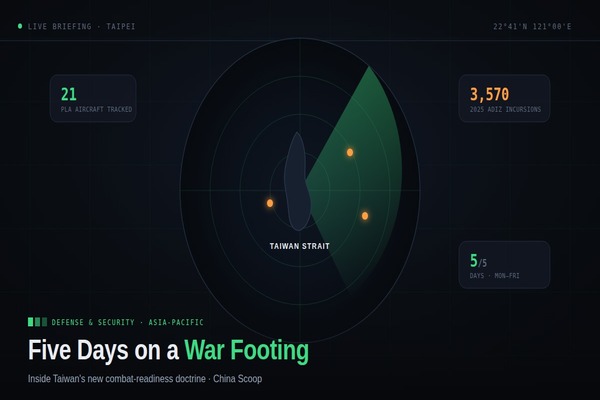
Taiwan’s Ministry of National Defense (MND) reported around 130 PLA aircraft in a single 24‑hour period, with roughly 90 crossing the median line of the Taiwan Strait one of the highest daily figures on record. Simultaneously, dozens of PLA Navy and China Coast Guard vessels operated around the island, including an amphibious task group with a Type 075 landing helicopter dock practising air‑assault and port‑seizure scenarios. Live‑fire rocket launches landed closer to Taiwan’s waters than in prior drills, with Taipei describing some impacts as the “closest ever Chinese live‑fire exercise” near its territory.
Blockade Rehearsal and Global Economic Stakes
A central feature of Justice Mission 2025 was simulated blockade operations against Taiwan’s critical ports, especially Kaohsiung and Keelung. Analysts noted tactics geared toward cutting off maritime trade vital to Taiwan’s energy and food imports, echoing wargame findings that Taipei could exhaust natural gas reserves within days under a sustained blockade.
Taiwan manufactures over 60 percent of global semiconductors and more than 90 percent of leading‑edge chips used in smartphones, EVs and advanced computing. A prolonged blockade or high‑end conflict would choke global electronics supply chains, with some studies putting potential losses in the hundreds of billions of dollars and disrupting roughly one‑fifth of world trade that transits the Taiwan Strait by value. During the drills, domestic and regional air traffic suffered: dozens of flights were cancelled or rerouted and connections to offshore islands such as Kinmen and Matsu were temporarily halted.
Trigger: Record US Arms Package and Hypersonic Signaling
Washington approved an unprecedented $11.1 billion arms package for Taiwan on 17 -18 December 2025 the largest single transfer ever featuring 82 HIMARS launchers, ATACMS/GMLRS munitions, 60 M109A7 howitzers, ALTIUS loitering munitions, Javelin/TOW anti-tank missiles, and network software to harden Taiwan’s asymmetric defenses.
Beijing denounced it as breaching the “one China” principle, explicitly tying Justice Mission 2025 to this “provocation” supporting “Taiwan independence.” China warned of imminent strait-wide crisis and publicized YJ-20 hypersonic anti-ship missile tests from Type 055 destroyers, bolstering A2/AD strategy to deter US carrier groups and allied intervention
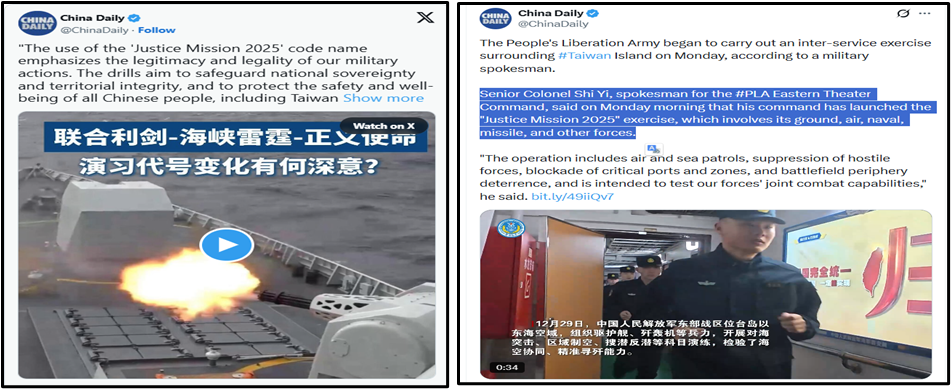
Beijing’s Messaging and Strategic Intent PLA officials framed the December 2025 drills as resolutely punitive and deterrent. Eastern Theater Command Spokesperson Senior Colonel Shi Yi called it a “stern warning” against “Taiwan independence separatists and external interference.” China Military Bugle declared reunification “how and when, not if,” with graphics depicting Taiwan bound in chains under slogans vowing to “punish Taiwan independence” and “deter external meddling.”
PLA scholars stressed the “Justice Mission” name asserts legal legitimacy for sovereignty defense. Beyond rehearsals of blockade tactics and joint fires, the exercise tested multi-service C2 while signaling resolve ahead of the PLA’s 2027 readiness deadline.
Taiwan’s Military and Political Response
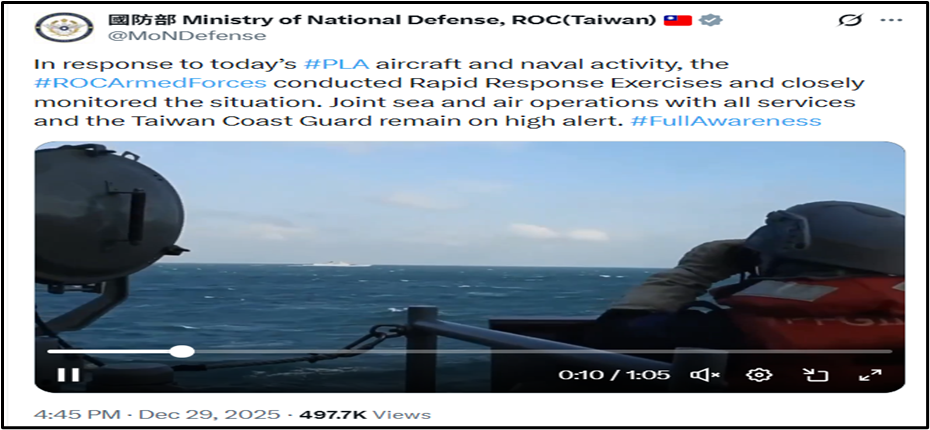
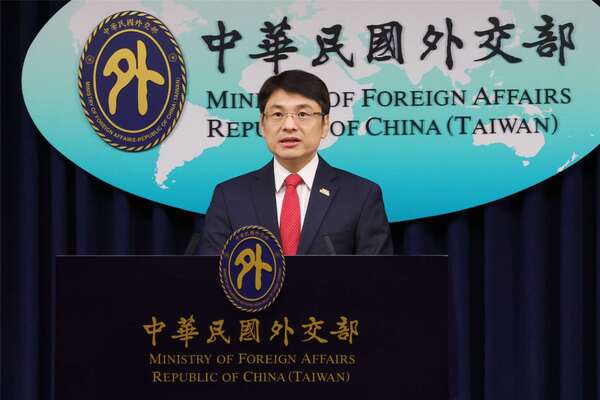
Taipei condemned the drills as “irrational and provocative,” charging Beijing with endangering civilians through abrupt navigation/airspace warnings that flout international norms and erode the rules-based order. Taiwan’s MOFA warned of “grave damage” to regional stability across the strait and Indo-Pacific.
MND surged patrols, scrambled fighters, and staged readiness drills featuring M1A2 Abrams tanks at Tamsui River approaches while displaying HIMARS to signal long-range strike evolution. Amid opposition blocking Lai Ching-te’s $40B defense budget and impeachment bids, Beijing exploits fractures to undermine the DPP while elevating accommodationist factions.
US Assessments and the 2027 Deadline
For Washington, Justice Mission 2025 is assessed within a broader pattern of PLA modernization and rehearsal for Taiwan contingencies. The Pentagon’s 2025 China Military Power Report concludes that despite internal turmoil and corruption probes, the PLA is still on track to meet Xi Jinping’s directive to be ready by 2027 to fight and win a war over Taiwan, if ordered.
The report describes a portfolio of options under active development including amphibious invasion, large‑scale firepower strikes and maritime blockade many of which have been tested in recent exercises since 2022. Justice Mission 2025 fits squarely within this pattern, emphasizing joint firepower, blockade tactics and anti‑intervention capabilities designed to hold US and allied forces at risk out to 1,500–2,000 nautical miles.
Yet President Donald Trump publicly downplayed the immediate risk of conflict, telling reporters he was “not worried” and characterizing Chinese drills as part of a long‑standing pattern, even as his administration approved the record arms package that helped trigger the latest escalation.
Taken together, Justice Mission 2025, record US arms sales, Japan’s growing willingness to frame Taiwan as a matter for collective self‑defense, and the PLA’s 2027 readiness push are producing a far more volatile strategic environment. American and allied intelligence assessments underscore that Beijing is no longer content simply to deter a formal declaration of independence; instead, it is applying sustained coercive pressure to force movement toward unification on its terms.
At the same time, key crisis‑management channels between Beijing and Taipei remain largely absent, increasing the risk that a miscalculation during high‑tempo operations—such as a rocket landing on Taiwanese territory or a collision at sea—could spiral into a broader confrontation neither side currently seeks. Justice Mission 2025 thus illustrates not only the maturation of PLA operational capabilities but also the tightening window in which regional actors must strengthen deterrence, build redundancy into economic networks, and establish communication mechanisms capable of managing a crisis that is edging ever closer to the threshold of war.






Leave a Reply