


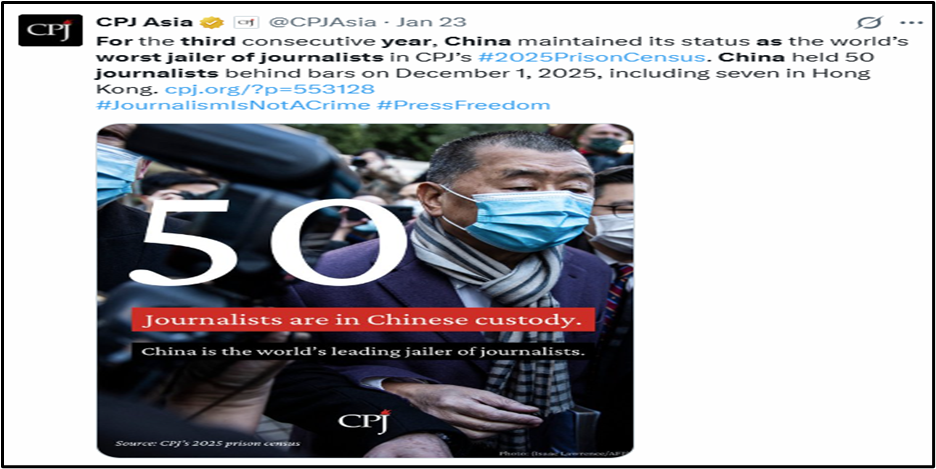
For the third straight year in 2025, China has cemented its grim status as the world’s worst jailer of journalists.. As per the Committee to Protect Journalists’ (CPJ) 21 January 2026 report, China imprisoned 50 reporters, an all time high amid a ruthless repression via arrests, surveillance and censorship. Nowhere is this crackdown more brutal than in Tibet and Xinjiang. There, any independent reporting on ethnic strife or protests is branded a threat to state security. This fuels Beijing’s iron fisted control over the ‘independent media.’
According to the thetibetpost.com, The Committee to Protect Journalists released its yearly Prison Census on 21 January 2026. It found 330 journalists in jail around the world as of 1 December 2025. This is a small drop from 384 the year before, but the number is still very high. China held the most at 50, including seven in Hong Kong. This beat Myanmar with 30 and Israel with 29. Most of Israel’s cases were Palestinian reporters during the Gaza war. The report is titled “2025 journalist jailings remain stubbornly high; harsh prison conditions pervasive.” It mentions countries like China, Turkey, Iran, Ethiopia, Egypt, and Myanmar see news about opposition as a danger to the state.
In China, at least 34 of the 50 jailed reporters faced vague charges like “subversion of state power” or “inciting subversion of state power.” These broad laws let the Communist Party label normal journalism such as reporting on protests, interviewing activists, or questioning policies as a crime against the state. This makes it easy to silence critics without clear evidence, tying directly into China topping the CPJ’s global list for the third year running.
Jimmy Lai, a British-Hong Kong newspaper owner of the now closed Apple Daily, faces a possible life sentence in a national security trial. His pro-democracy writing and interviews are called “collusion with foreign forces.” Academic Dong Yuyu, a former editor, got seven years for alleged spying after sharing info with a foreign reporter. Both won CPJ’s top press freedom awards, showing how even awards don’t protect truth tellers.
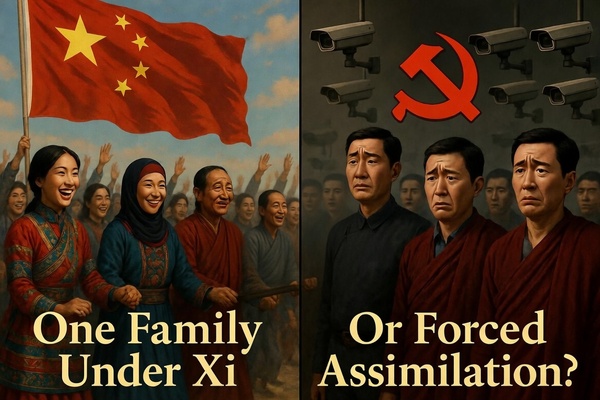
CPJ reports nearly one third of all jailed journalists worldwide around 110 people faced abuse like torture, beatings or denied medical care. In China, this is routine. It hits hardest in Tibet and Xinjiang, Tibetan reporters get arrested for Dalai Lama stories, self-immolations, or protests against mining sacred lands, often charged with “splittist” for talking to exile media. In Xinjiang, Uyghur journalists covering camps, forced labor, or cultural loss face “extremism” labels, with many tortured or disappeared.
This pattern matches the global trend in the CPJ census: 61% of cases use anti-state charges. It links to Hong Kong’s seven prisoners under the 2020 security law and explains why China holds 15% of world cases. Beijing’s strategy pre-empts bad news, especially in sensitive regions, fuelling the “iron-fisted control”. As CPJ urges international pressure, these abuses show press freedom under siege, with no quick fix in sight. Controls are stronger in Tibet and Xinjiang. Any tough reporting is seen as a big threat. Arrests rise for links to exile media or rights stories. China holds 15% of all cases worldwide.
Beijing’s approach is clear: independent journalism is a threat to the narrative of control. Arrests rise not just to punish, but to pre-empt reporting, particularly on sensitive ethnic and political issues. Until international pressure translates into real protections, the fate of journalists in China and the flow of truth remains precarious.









Leave a Reply