

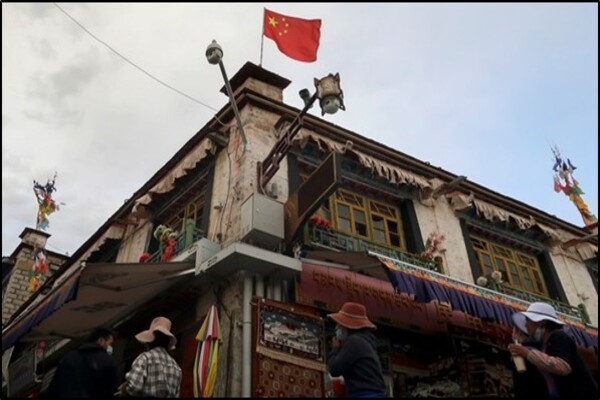
The recent installation of high-definition CCTV arrays around Taktser, a modest village in the Ammo region (modern-day Qinghai), marks a chilling escalation in Beijing’s decades-long campaign to dismantle Tibetan identity. To the uninitiated, these cameras might appear as routine security, to Tibetans, they represent the transformation of a sacred birthplace into a digital panopticon. By monitoring the cradle of the 14th Dalai Lama, the Chinese Communist Party (CCP) is not just tracking movement it is attempting to sever the spiritual umbilical cord connecting the Tibetan people to their exiled leader.
In the eyes of the Chinese Communist Party (CCP), a humble village in Qinghai province is not a historical site of spiritual significance, but a volatile node of “separatism” that must be neutralized through the cold lens of predictive policing.
This strategy of “securitization” has become the hallmark of China’s domestic policy under its current leadership, signaling an era where the state no longer seeks just the loyalty of its citizens, but the total transparency of their inner lives.
The Panopticon of the Plateau
For the Tibetan people, the village of Takster is a bridge to their spiritual leader and a physical manifestation of their heritage. For Beijing, it is a security risk. By saturating the area with surveillance technology, the CCP has effectively turned a pilgrimage site into a panopticon.
The psychological impact of this cannot be overstated. When a devotee knows that every prostration, every whispered prayer, and every gathering of three or more people is being logged and analyzed by facial recognition software, the act of worship is transformed into an act of courage or, as the state intends, an act of fear. This is psychological domination by design. It aims to fracture the communal bonds of the Tibetan people, making the cost of cultural expression too high for the average citizen to bear.
A Broader Pattern: From Lhasa to Kashgar
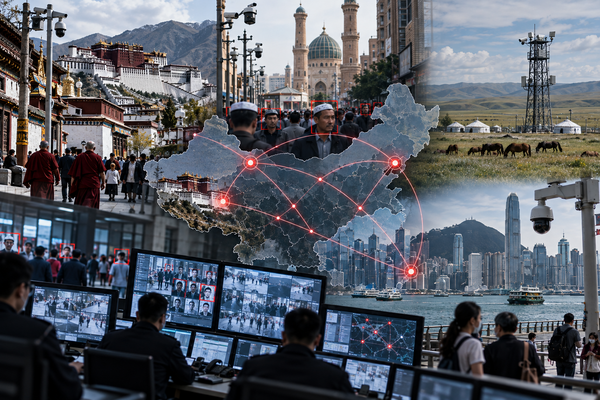
The surveillance in Takster represents a localized application of a much larger, systemic strategy of ethnic control across Tibet and Xinjiang. This “dystopian” framework relies on the Integrated Joint Operations Platform (IJOP) and “Grid Management” systems to ensure total state visibility. In Xinjiang, the CCP utilizes invasive biometric data collection including DNA and iris scans alongside a dense network of physical checkpoints and mandatory smartphone monitoring apps to restrict digital and physical movement.
This blueprint is mirrored in Lhasa, where the city is subdivided into high-density cells. Each grid is monitored by dedicated personnel and pervasive camera networks, effectively stifling organized protest and the distribution of unsanctioned religious materials. By integrating high-tech digital enclosure with granular neighborhood policing, the state maintains a “vast tapestry” of surveillance designed to pre-emptively neutralize dissent and enforce cultural and political conformity among minority populations.
The Statistics of Suppression
China’s internal security infrastructure is defined by a massive allocation of financial and technological resources aimed at maintaining domestic stability. As of the early 2020s, the national “stability maintenance” budget was estimated at approximately $210 billion, a figure that significantly rivals and at times exceeds official spending on external national defense. This financial commitment supports a surveillance network of over 700 million CCTV cameras, representing nearly half of the global total and creating a ratio of roughly one lens for every two citizens.
In regions like Xinjiang, this apparatus is particularly dense, with a security personnel-to-citizen ratio as high as 1:30, supported by “convenience police stations” placed every few hundred meters. While the Chinese government maintains these measures are for counter-terrorism, international bodies like the UN and various human rights organizations estimate that, at its peak, over 1 million Uyghurs and other minorities were held in “re-education” camps. This integrated system of digital surveillance, high-density policing, and mass detention represents an unprecedented scale of state-led internal control
The Resilience of Identity
The installation of cameras in the Dalai Lama’s birthplace is an admission of weakness, not strength. It reveals a state that is deeply insecure, one that views the simple act of a pilgrimage as an existential threat. If the CCP’s ideology were truly resonant with its minority populations, it would not require a multi-billion-dollar apparatus of facial recognition and predictive policing to maintain order.
By turning Takster into a monitored zone, Beijing may control the movement of bodies, but it struggles to capture the loyalty of the mind. As long as the global community remains vigilant and the stories of these regions continue to be told, the attempt to erase these identities will remain an unfinished project.

















Leave a Reply