

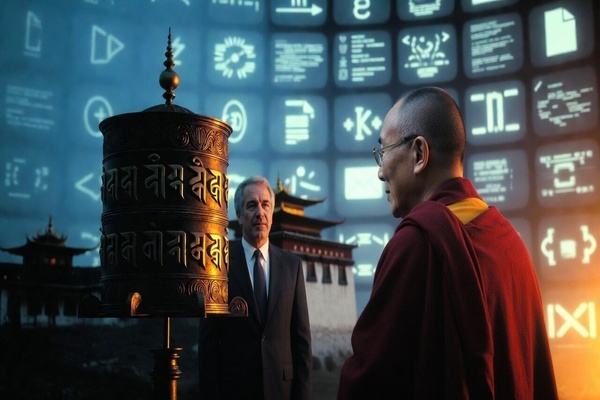
In the high-stakes world of international diplomacy and information warfare, few figures draw the ire of the Chinese Communist Party (CCP) like the 14th Dalai Lama. For decades, the spiritual leader has been the face of Tibetan identity and the struggle for autonomy a status Beijing has consistently sought to undermine. In early 2026, a new and unexpected weapon emerged in this long-standing conflict, the so-called “Epstein Files.”
The intersection of a revered Nobel Peace Prize laureate and the archives of a disgraced American financier may seem like an impossible Venn diagram. However, through a calculated campaign of digital manipulation, state-run media narratives and social media amplification, Beijing has attempted to bridge that gap, turning a massive data dump into a tool for character assassination.
The Catalyst: The 2026 Epstein Data Release
The catalyst struck in late January 2026. The U.S. Department of Justice unsealed over three million pages of investigative documents emails, flight logs, contact lists and more. Intended to deliver accountability and closure for Epstein’s victims, the deluge instead created a misinformation playground. Within 48 hours, outlets like China Global Television Network (CGTN) and Ecns.cn blared headlines: the Dalai Lama’s name appeared “at least 169 times.” They painted this as damning evidence of complicity, implying shadowy ties to Epstein’s predatory network. Yet, as independent verifiers would soon reveal, the files offered no such smoking gun.
Anatomy of a Smear: Debunking the “169 Mentions” Myth
At first glance, 169 mentions of the Dalai Lama in the Epstein files suggest a close tie, but forensic analysis reveals a banal reality. These references divide into three innocuous categories. First, third-party emails among Epstein’s associates discuss public events featuring the Dalai Lama, like one where a sender skips a meeting to attend his nearby speech. Second, aspirational lists show Epstein name-dropping moral icons like the Dalai Lama to elevate his image, with no actual contact. Third, trivial scans, such as a Massage for Dummies index referencing his teachings, inflate the count.
Fact-checkers AFP and the Tibet Rights Collective confirm zero evidence of meetings, correspondence, or funds. Yet, this fabricated “fact” powers a viral disinformation campaign, amplified by state media to smear the spiritual leader. It exemplifies how a kernel of data, stripped of context, fuels propaganda turning mundane mentions into perceived guilt.
Strategic Timing: Epstein Smear Hits at Grammy Glory and Succession Crisis
Beijing’s orchestration was impeccably timed, synchronizing with dual flashpoints. Just weeks later, in February 2026, the Dalai Lama clinched a Grammy for his audiobook Meditations, a cultural coup that amplified his global voice on peace and mindfulness. China branded it “anti-China meddling,” but the Epstein narrative hit like a precision strike, muddying his victory with tabloid slime. Deeper still, it pierced the succession saga. At 90, the Dalai Lama’s reincarnation process looms large, Tibetan tradition dictates a successor chosen spiritually, not politically. By tainting the 14th’s legacy, the CCP erodes that lineage’s credibility, priming the ground for a state-sanctioned rival echoing their “Panchen Lama” playbook from the 1990s.
A Pattern of Transnational Repression
This is not the first time Beijing has utilized “moral panic” to attack the Dalai Lama. In 2023, a heavily edited video of the leader interacting with a child was circulated globally, accompanied by CCP-aligned bots and influencers who stripped the clip of its Tibetan cultural context a playful linguistic tradition known as “Che le sa” (eat my tongue).
The Epstein campaign represents an evolution of this strategy. It leverages Western sensitivities the visceral disgust toward the Epstein circle to alienate the Dalai Lama from his Western support base. It is a “firehose of falsehood” approach, flooding the digital space with so many claims that the truth becomes too exhausting for the average user to find.
The “Epstein Files“ controversy is a textbook example of how modern information warfare operates. By taking a kernel of truth (the appearance of a name in a database) and stripping away context, the CCP has attempted to transform a spiritual icon into a tabloid villain.
As the Office of the Dalai Lama stated in its unequivocal denial on February 8, 2026: “His Holiness has never met Jeffrey Epstein or authorized any meeting.” In the digital age, however, the challenge for the Tibetan community is not just proving a negative, but surviving a relentless tide of state-sponsored narrative warfare designed to win by exhaustion rather than evidence.













Leave a Reply