

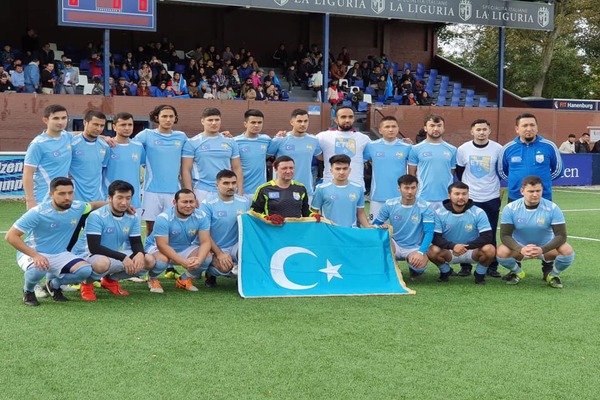
The Uyghur-Tibetan-Mongolian Freedom Cup football tournament is set to take place later this month in New York City, bringing together diaspora communities whose shared histories are marked by struggle, cultural survival, and resistance to authoritarian control. According to announcements shared by the East Turkistan National Football Team and reported by Uyghur Times, the tournament will be held at Randall’s Island Park in Manhattan, with matches involving Uyghur, Tibetan, and Mongolian teams. The event is expected to begin on May 28, 2026, at 6:00 p.m., with the playing of the East Turkistan national anthem and the Tibetan national anthem, followed by the opening match between the Uyghur and Tibetan teams.
More than a sporting competition, the Freedom Cup represents a powerful public statement by communities that have long used culture, identity, and international solidarity to keep their causes alive. For Uyghurs, Tibetans, and Mongolians living in exile, football is not only a game played on a field. It is a platform where memory, identity, and political expression come together. In a global city like New York, the tournament carries symbolic weight: communities pushed to the margins by state repression will gather in one of the world’s most visible public spaces to declare that their voices, flags, languages, and histories remain alive.
The tournament schedule reflects both athletic competition and community engagement. After the opening match on May 28, the Uyghur team is expected to visit the Tibetan football community the following day. On May 30, evening matches are scheduled between the Uyghur and Mongolian teams and between the Mongolian and Tibetan teams. The event is expected to conclude with a press statement, underlining that the tournament’s purpose extends beyond the final score.
The East Turkistan National Football Team has become an important symbol of Uyghur identity in exile. The East Turkistan Football Association says it was founded in 2019 and describes itself as the first East Turkistan national football association since 1949. It says it oversees amateur and professional football activity across East Turkistanian diaspora communities and is active through member leagues in countries including the United States, Canada, Norway, Sweden, the Netherlands, Germany, Belgium, France, and Australia.
This global spread gives the tournament an international character. Uyghur players are expected to travel to New York from both the United States and Europe. Ilshat Islam, coach of the East Turkistan National Football Team, told local media that many players currently play for different local football clubs and are preparing seriously for the competition. The players are expected to arrive in New York on May 26 and take part in two days of training before the official matches begin.
Among the players named in reports is Abdushukur Abduréhim, a Norway-based Uyghur footballer who currently plays for Singapore’s Geylang football club. His participation highlights how diaspora athletes often carry more than sporting responsibility. They represent communities scattered by political pressure, migration, exile, and the search for safety. When such players wear national or community colors, they become visible ambassadors of identity.
The tournament also reflects the growing cooperation among Uyghur, Tibetan, and Mongolian communities. These groups have different histories, languages, and religious traditions, yet they share concerns over Chinese Communist Party policies involving assimilation, surveillance, political control, and restrictions on cultural and religious life. In exile, these communities often find common ground in public advocacy, cultural preservation, and international awareness campaigns.
For Tibetans, football has also become part of a broader cultural and political identity in exile. Tibetan teams have participated in alternative international sporting platforms that give stateless or unrecognized communities a place to compete. For many Tibetan supporters, matches are not only about winning but about visibility. Every appearance of the Tibetan flag, anthem, and team name becomes a reminder that Tibet’s identity continues despite decades of political pressure.
The Uyghur and Tibetan teams have already met in recent competition. According to Uyghur Times, they previously competed during a CONIFA football tournament held in London, where the Uyghur team defeated Tibet 3–2. The East Turkistan team is also listed as a member of CONIFA, a football body that provides competitive opportunities for teams outside FIFA’s official structure.
The Mongolian team’s participation adds another important dimension. Southern Mongolian activists and diaspora communities have raised concerns for years over language rights, cultural autonomy, land issues, and state-led assimilation policies. By joining Uyghur and Tibetan teams in the Freedom Cup, Mongolian participants help transform the event into a broader symbol of solidarity among peoples who see themselves as defending heritage against forced homogenization.
Sport has long served as a peaceful way for marginalized communities to build identity and attract global attention. Unlike formal diplomacy, football can reach ordinary people quickly. A match can bring together families, youth, activists, students, and community leaders in a setting that feels both celebratory and political. The Freedom Cup uses that power. It presents the struggles of Uyghurs, Tibetans, and Mongolians not only through reports and speeches, but through movement, teamwork, flags, songs, and public gathering.
The timing is also significant. Organizers say the tournament aims to raise international awareness about issues facing East Turkistan and Tibet at a moment when global attention is focused on football events taking place in New York. This strategy is important: when major cities host global sporting activities, public attention expands, and community-led events can use that energy to reach wider audiences.
Financial and logistical support remains a challenge. Public appeals shared online by Uyghur figures, including Rebiya Kadeer and Sirajidin Fatih, have urged Uyghurs in the diaspora and supporters of the East Turkistan cause to provide moral and financial assistance. According to the statement reported by Uyghur Times, the East Turkistan National Football Team faces financial difficulties, and supporters have described helping the team as an urgent community responsibility.
Such challenges are common for diaspora teams. Unlike state-backed national teams, these players and organizers often depend on donations, volunteers, community networks, and personal sacrifice. Travel, training, accommodation, uniforms, venue costs, equipment, and media outreach require resources. Yet these limitations also make the tournament more meaningful. It is not built by government budgets or corporate sponsorships, but by communities determined to preserve dignity and identity.
For young members of the Uyghur, Tibetan, and Mongolian diasporas, the Freedom Cup can become a living lesson in identity. Many young people born or raised outside their ancestral homelands may know their history through family stories, community schools, religious centers, protests, and cultural events. A football tournament gives them another form of connection. It allows them to see their heritage not only as a memory of suffering, but as something active, proud, and shared.
The event also sends a message to the wider public: these communities are not defined only by victimhood. They are communities of athletes, organizers, families, artists, students, and professionals. They compete, celebrate, build institutions, and create international networks. The Freedom Cup therefore challenges the silence imposed by authoritarian narratives. It says that identity survives not only in protest, but also in play, discipline, friendship, and collective joy.
At Randall’s Island Park, the sound of national anthems, the sight of community flags, and the energy of supporters will turn a football field into a space of remembrance and resistance. For Uyghurs, Tibetans, and Mongolians, the tournament will likely be remembered not only by goals scored, but by the unity displayed. It will be a reminder that oppressed communities can stand together without losing their distinct identities.
The Uyghur-Tibetan-Mongolian Freedom Cup is therefore more than a tournament. It is a statement of survival. It is a call for recognition. It is a celebration of cultures that continue despite repression. In New York, three communities will meet through football, but the message will go far beyond the pitch: freedom, identity, and solidarity cannot be erased.





Leave a Reply