

A sharp rise in reports of Taiwanese citizens going missing, being questioned or having their freedom restricted in China is generating growing concern across Taiwan. The cases involve not only political activists, but also civil servants, religious followers, academics, business travellers and ordinary tourists.
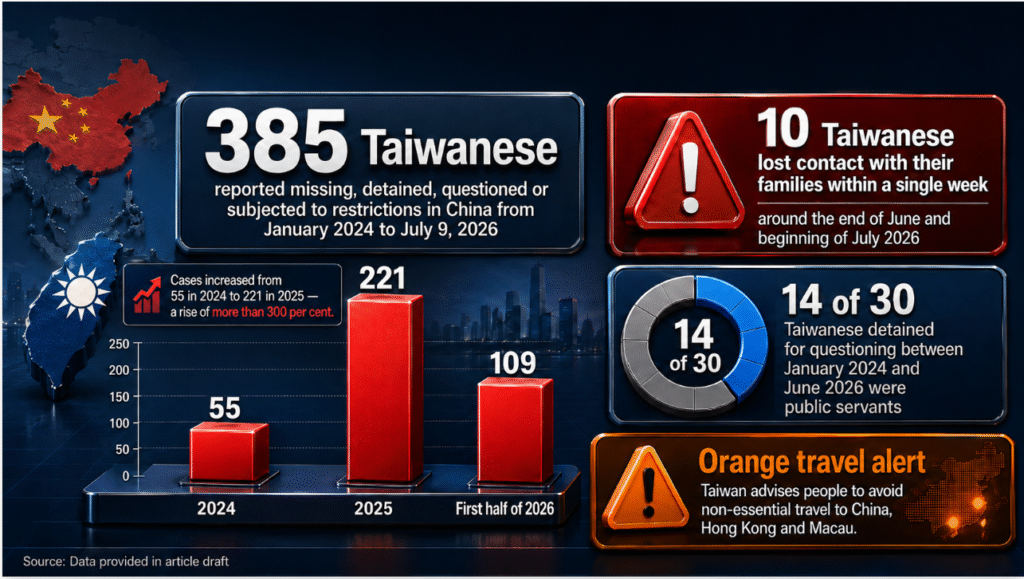
According to Taiwan’s Mainland Affairs Council, or MAC, 385 cases were reported between January 2024 and July 9, 2026. The annual figures show a worrying upward trend: 55 cases in 2024, 221 in 2025 and 109 during the first half of 2026. The number recorded in 2025 was more than four times the total reported a year earlier.
The Numbers Behind the Growing Crisis
- 385 Taiwanese were reported missing, detained, questioned or subjected to restrictions in China from January 2024 to July 9, 2026.
- Cases increased from 55 in 2024 to 221 in 2025, a rise of more than 300 per cent.
- 109 cases were recorded in the first half of 2026.
- Ten Taiwanese lost contact with their families within a single week around the end of June and beginning of July 2026.
- Of 30 Taiwanese detained for questioning between January 2024 and June 2026, 14 were Taiwanese public servants.
- Taiwan maintains an orange travel alert for China, Hong Kong and Macau, advising people to avoid non-essential travel.
The total of 385 covers different types of incidents and should not be interpreted as meaning that every individual was formally arrested or accused of a political offence. Some were reported missing after losing contact with relatives, while others were interrogated, prevented from leaving, ordered to remain in a particular location or subjected to other restrictions.
Earlier MAC figures provide a clearer indication of the categories involved. Of the 313 cases recorded from January 2024 through February 2026, 114 involved people reported missing, 25 involved detention or interrogation and 174 involved restrictions on personal liberty. An equivalent breakdown for the latest total of 385 has not yet been publicly provided.
Ten disappearances in one week
The immediate concern intensified after the families of ten Taiwanese citizens reported losing contact with them during a single week. Four were travelling together and had completely disappeared from contact. One had travelled to China to visit relatives, another had gone there for employment, while the reasons for the other journeys were either unknown or had not been disclosed.
Taiwanese authorities said they were attempting to determine whether the individuals had encountered private difficulties, had been detained by Chinese officials or were facing some other form of restriction. The lack of information highlights one of Taipei’s biggest concerns: Chinese authorities are no longer consistently informing Taiwan when its residents are detained or investigated.
The MAC says it often learns about such cases only after relatives report that a traveller has stopped answering messages or telephone calls. The absence of regular official notification can leave families uncertain about whether their relatives are safe, under investigation or being held incommunicado.
A judge questioned at his hotel
One case disclosed by Taiwanese officials involved a district court judge who travelled to northern China in April 2026. Three Chinese public-security officers reportedly approached him at his hotel after already identifying his profession.
The officers asked about his work, the differences between the Taiwanese and Chinese judicial systems, his political views and his opinion of cross-strait exchanges. They also allegedly attempted to establish contact with him through WeChat.
The incident raised concern because the judge had not publicly been accused of committing a crime. Taiwanese officials interpreted the questioning as evidence that Chinese agencies can identify and monitor Taiwanese visitors through hotel registrations, immigration records, cellphone information and other surveillance systems.
The MAC reported that 30 Taiwanese were detained for questioning between January 2024 and June 2026. Fourteen of them were public servants, prompting the government to advise civil servants, judges, police officers, military personnel and employees in sensitive industries to avoid unnecessary travel to China.
Religious followers among those detained
Religious activity has emerged as another source of risk. MAC Minister Chiu Chui-cheng said that 20 Taiwanese had been detained in China since January 2025 for religious activities. The group reportedly included 18 followers of I-Kuan Tao and two members of the Unification Church.
Some were in their 60s and 70s. Three had returned to Taiwan by June 2026, while 15 I-Kuan Tao followers reportedly remained in China. I-Kuan Tao operates legally in Taiwan but is not officially permitted in China, where religious organisations are required to function under state-approved structures.
The cases demonstrate how activities considered lawful and ordinary in Taiwan can be treated very differently under China’s political and legal system.
Expanding national-security laws
Taiwanese authorities argue that the increase is connected to China’s expanding national-security framework. Beijing has strengthened its Anti-Espionage Law, National Security Law, National Intelligence Law, state-secrets legislation and data-security rules.
Taipei warns that broadly defined provisions could allow ordinary activities—such as taking photographs, using GPS equipment, conducting academic research, gathering commercial information or speaking with local residents—to be interpreted as threats to national security.
Concern increased further after China’s Ethnic Unity and Progress Promotion Law took effect on July 1, 2026. Taiwanese officials say provisions concerning separatism and conduct outside China could potentially be applied to Taiwanese citizens. Beijing rejects this interpretation and says the law is intended to protect ethnic equality, unity and legitimate cultural rights.
China’s Taiwan Affairs Office has also denied accusations of vague criminalisation, describing Taipei’s warnings as politically motivated fabrications intended to create fear and obstruct cross-strait exchanges.
However, China’s June 2024 judicial guidelines on punishing what Beijing calls “die-hard Taiwan independence separatists” remain a major source of anxiety. The guidelines allow severe penalties, including the death penalty in cases Chinese authorities classify as exceptionally serious.
In one prominent example, Taiwanese activist Yang Chih-yuan was sentenced to nine years in prison in 2024 for separatism. Human Rights Watch said the conviction was based partly on political activities conducted in Taiwan, increasing fears that Beijing could punish people for lawful expression outside China.
Travel continues despite the warnings
Despite these concerns, travel between Taiwan and China remains substantial. Approximately 3.24 million Taiwanese visited China in 2025, nearly 17 per cent more than in 2024. The figure was nevertheless about 20 per cent below the pre-pandemic peak of 4.05 million visits in 2019.
Family connections, employment, business, education, tourism and religious exchanges continue to draw Taiwanese visitors across the strait. This means a complete halt in travel is unlikely, even as political relations deteriorate.
Taiwan’s orange travel alert does not prohibit visiting China. It advises citizens to avoid non-essential trips, evaluate their personal and professional risk and register their travel details with the government before departure.
A growing chilling effect
The broader impact may extend beyond the 385 reported cases. Political analysts warn that uncertainty over what China considers illegal could create a chilling effect inside Taiwan.
People considering a visit may begin reviewing old social-media comments, political statements, religious affiliations, professional connections and participation in public demonstrations. Even Taiwanese who do not consider themselves politically active could fear that an online post, photograph or workplace association might attract attention.
The dispute therefore concerns more than traveller safety. It reflects the growing collision between Taiwan’s democratic freedoms and China’s expansive national-security system. Until there is greater transparency, reliable notification of detentions and clearer legal protection for visitors, each new disappearance is likely to deepen Taiwanese public distrust of cross-strait exchanges.







Leave a Reply