

China is pouring billions of dollars into Buddhism funding temples, universities, pilgrimage sites and religious institutions across Asia in a calculated effort to reshape the faith’s future and expand its influence. At the heart of this campaign lies a high-stakes struggle over who will control the succession of the Dalai Lama, a battle that has turned an ancient spiritual tradition into a modern geopolitical contest with neighbouring India. For an officially atheist Communist state, the embrace of religion may look like a contradiction. In reality, it is one of the most deliberate soft power strategies of the Xi Jinping era.
Why Would an Atheist State Invest Billions in Religion?
The Chinese Communist Party has never abandoned its founding scepticism toward faith. Mao Zedong once reportedly told the Dalai Lama that religion was “poison.” Yet under Xi Jinping, Beijing has recognised that Buddhism followed by nearly half a billion people, the overwhelming majority of them in Asia is a powerful instrument of statecraft.
China now presents itself as the world’s largest Buddhist nation, claiming roughly 300 million believers across various schools. It has spent hundreds of millions of dollars restoring monasteries and religious sites, and has woven Buddhist outreach directly into its trillion-dollar Belt and Road Initiative. The logic is simple: in Buddhist-majority nations like Nepal, Sri Lanka, Myanmar and Mongolia, shared faith becomes a bridge for economic and diplomatic influence. Beijing has even promoted the idea of a shared regional Buddhist heritage to help legitimise its broader ambitions across the continent.
This is what analysts call the “Sinicization” of religion an effort to bring faith under state control, make it reliant on state-backed leadership, and align it with a single national identity. The elite United Front Work Department, tasked with managing religious groups and overseas influence, sits at the centre of this machinery.
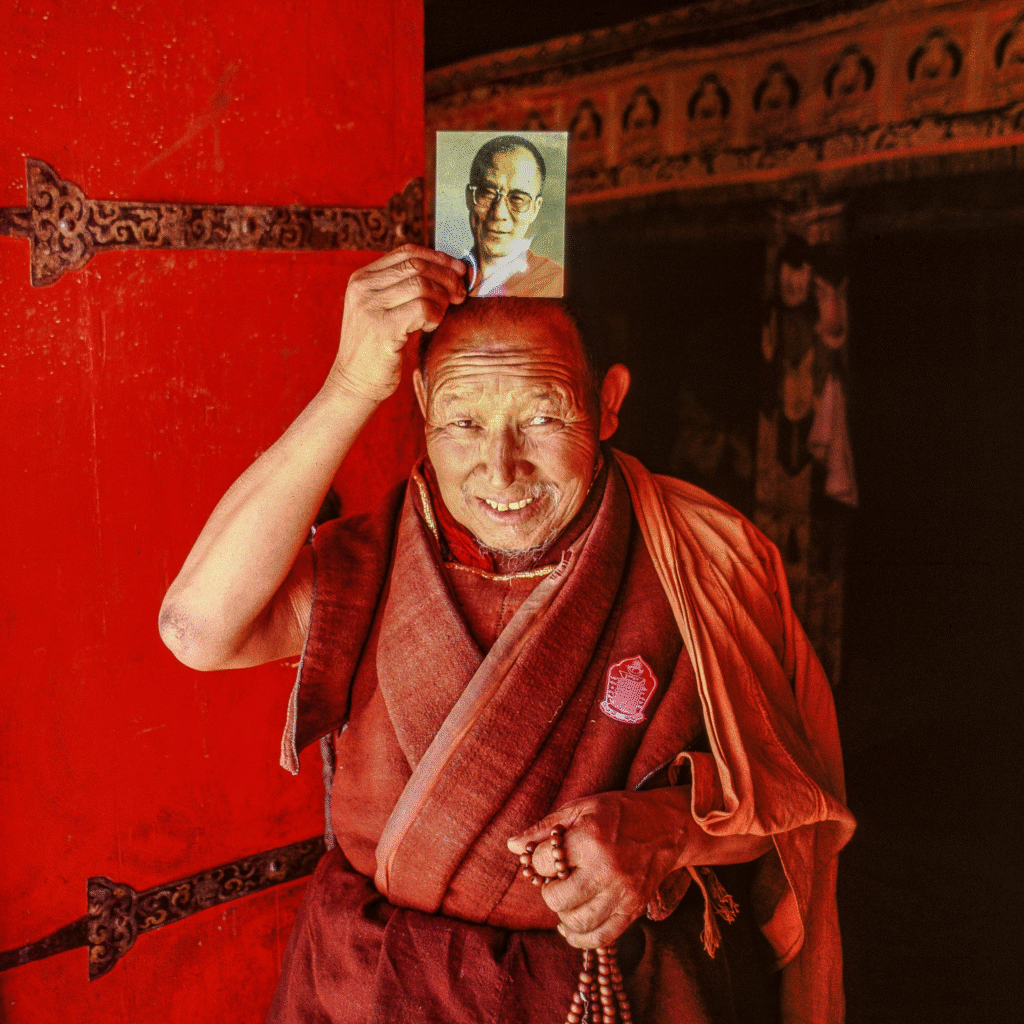
The Dalai Lama Succession: The Ultimate Prize
Nowhere are the stakes higher than in the looming battle over the Dalai Lama’s succession. The spiritual leader of Tibetan Buddhism, who turned 90 in 2025, fled Tibet in 1959 after a failed uprising against Chinese rule and has lived in exile in Dharamshala, India, ever since. His eventual passing will trigger one of the most consequential religious successions of the century.
Tibetan Buddhists believe the Dalai Lama is reincarnated in the body of a child after his death a sacred process guided by senior monks, visions, oracle lakes and traditional signs, refined over more than 600 years. But Beijing insists that it holds the authority to approve the next Dalai Lama, and has signalled it will use a Qing-dynasty ritual of drawing lots from a golden urn, under state supervision, to install its own candidate.
The Dalai Lama has firmly rejected this. He has declared that the institution will continue and that sole authority over recognising his successor rests with the Gaden Phodrang Trust, the office he established for exactly this purpose. The result is a collision course: when he passes, the world may witness two rival Dalai Lamas one chosen by Tibetans in exile according to tradition, and another appointed by the Chinese state.
A Warning From History: The Panchen Lama
This scenario is not hypothetical. It has already happened once. In 1995, the Dalai Lama identified a six-year-old boy, Gedhun Choekyi Nyima, as the reincarnation of the Panchen Lama the second-most important figure in Tibetan Buddhism. Within days, the boy disappeared into Chinese custody. Beijing installed its own candidate, Gyaincain Norbu, in his place.
Three decades later, that Beijing-appointed Panchen Lama is an active instrument of Chinese religious diplomacy. His invitation to Lumbini, the Buddha’s birthplace in Nepal, in 2024 reportedly prompted intense diplomatic pressure from India and the United States, who feared it would strengthen China’s claim to determine the next Dalai Lama. The episode revealed just how far Beijing’s religious influence now reaches beyond its own borders.
Nepal and Lumbini: The New Battleground
Nepal has become a focal point of the rivalry. Chinese contractors built an international airport designed to funnel pilgrims and tourists toward Lumbini, and Chinese state-aligned institutions have backed an ambitious multi-billion-dollar expansion of Lumbini Buddhist University, complete with research centres, hotels and its own power supply.
This investment carries strategic dividends well beyond faith. The same buildup has opened access to significant mineral reserves and enabled major infrastructure projects across the Himalayan region — a reminder that Beijing’s Buddhist diplomacy and its economic ambitions are tightly interwoven.
India’s Response: The Birthplace Strikes Back
India holds a card China cannot match: Buddhism was born on Indian soil. The Buddha attained enlightenment at Bodh Gaya, and the country is home to the faith’s most sacred sites. For decades, though, India treated this heritage passively, hosting the Dalai Lama and the Tibetan government-in-exile gave it moral authority, but little strategic leverage.
That has changed. Under Prime Minister Narendra Modi, India has moved to convert its civilizational heritage into active diplomacy. Key initiatives include:
- Relic diplomacy: India has loaned sacred Buddha relics to Thailand and Vietnam for major public expositions, one of which drew nearly 15 million devotees, deepening ties with Buddhist-majority nations.
- The Piprahwa Gems: In early 2026, India moved to block the auction of rare sacred Buddhist relics and instead showcased them in a landmark New Delhi exhibition a pointed assertion of custodianship over Buddhist heritage.
- High-level pilgrimages: India has hosted leaders from Vietnam and Myanmar at Bodh Gaya, using sacred geography as a diplomatic stage.
- Institutional outreach: The International Buddhist Confederation, launched in 2011, serves as India’s counterweight to China’s World Buddhist Forum, which in 2024 drew around 800 monks and scholars from 72 countries.
Yet observers note that India has struggled to fully match China’s centralised, well-funded, long-term approach. As one former Indian envoy to China put it, Beijing’s Buddhist diplomacy aims to undermine India’s status as the true home of the faith, and has succeeded in part because India has been slower to organise its response.
Statecraft Versus Moral Authority
The deepest irony of this rivalry is that China’s greatest challenge may be immune to money. While Beijing spends billions to manufacture spiritual legitimacy, the Dalai Lama’s authority was built in exile, without state backing or wealth, rooted instead in compassion, dignity and a global moral appeal that cuts across religion and politics.
This exposes a fundamental miscalculation at the core of Beijing’s model: the belief that spiritual authority can be engineered through infrastructure and administrative control. Reincarnation, visions and the recognition of a tulku are traditions that lie beyond the reach of law or party decree. A state can install a candidate; it cannot manufacture the faith of those expected to follow him.
What Happens Next?
The coming years will test whether soft power can be bought or whether it must be earned. When the succession finally arrives, Buddhist communities worldwide, from Ladakh and Nepal to Mongolia and Southeast Asia may be forced to choose sides, escalating a quiet contest into an open diplomatic rupture. The decisive stage of the India-China rivalry may not be the trade routes or the disputed border, but the monasteries of the Himalayas, where spiritual symbolism masks a profound strategic struggle.
For now, one truth stands out: in the 21st-century contest between Asia’s two giants, faith itself has become a frontier and the future of Buddhism has become inseparable from the future of Asian power.
Frequently Asked Questions by our Visitors:
Why is China investing in Buddhism if it is an atheist state?
China uses Buddhism as a soft power tool to expand its influence across Buddhist-majority Asian nations, support its Belt and Road Initiative, and ultimately gain legitimacy for a Beijing-appointed Dalai Lama. The Communist Party sees religion as a strategic asset rather than a matter of belief.
Why does the Dalai Lama’s succession matter geopolitically?
Whoever controls the recognition of the next Dalai Lama influences the loyalties of roughly half a billion Buddhists and the strategically vital Himalayan region. Beijing wants to appoint its own candidate to cement control over Tibet, while the Dalai Lama insists the choice belongs solely to his own trust.
What advantage does India have over China in Buddhist diplomacy?
India is the birthplace of the Buddha and home to Buddhism’s holiest sites, giving it unmatched historical and civilizational legitimacy. It also hosts the Dalai Lama, lending it significant moral authority in the Buddhist world.
Could there really be two Dalai Lamas?
Yes. Analysts widely expect that after the current Dalai Lama’s death, Tibetans in exile will recognise a successor chosen through tradition, while China installs its own state-approved candidate, creating two competing claimants and effectively splitting Tibetan Buddhism.





Leave a Reply