

China’s Strategic Footprint in Pakistan-Administered Kashmir
Roads, dams and corridors are only the surface. Beneath them lies a deeper question: what does Beijing’s expanding presence mean for one of Asia’s most sensitive disputed regions?
China’s strategic footprint in Pakistan-administered Kashmir is no longer simply a story about roads, dams or economic investment. Instead, it is becoming a larger question about strategy, political influence, security and the future of one of Asia’s most sensitive disputed regions.
Through the China–Pakistan Economic CorridorCPEC: a flagship of China’s Belt and Road Initiative, connecting Xinjiang with Pakistan’s Arabian Sea coast through transport, energy and industrial projects., commonly known as CPEC, Beijing has developed major interests across Pakistan. The wider corridor connects China’s Xinjiang region with Pakistan and the Arabian Sea. Along this strategic network, areas administered by Pakistan in the broader Kashmir region have acquired growing importance.
Chinese-linked interests include transport connectivity, hydropower projects and infrastructure development. Pakistan and China describe these projects as engines of economic growth, electricity generation and regional connectivity. Supporters argue that such investment can create jobs, improve infrastructure and address Pakistan’s energy shortages.
But another question is becoming increasingly important:
The answer matters because these projects are not located in an ordinary political environment. They are connected to territories at the centre of the long-running India–Pakistan dispute over Kashmir. India has repeatedly objected to CPEC-related activity in territory it claims. This means that Chinese investment carries consequences far beyond economics.
Kashmir’s Strategic Importance to China
For Beijing, the wider Kashmir region matters for several reasons.
First, it is connected to China’s western frontier. Pakistan’s northern territories provide an important geographical link between Pakistan and China’s Xinjiang region. The Karakoram Highway has long symbolised this relationship, while CPEC has given the broader connection greater economic and strategic importance.
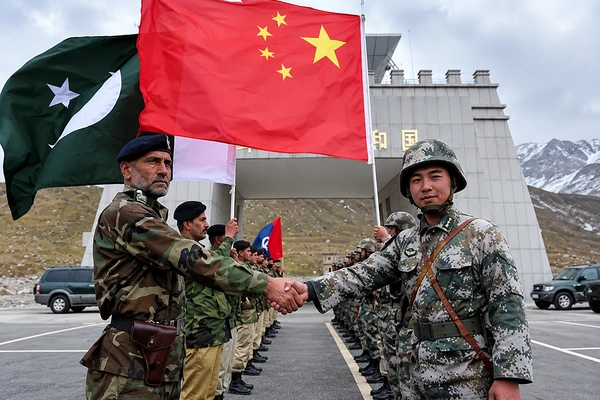
Second, the region is important to the China–Pakistan partnership. Beijing and Islamabad describe their relationship as an “all-weather” strategic partnership. Infrastructure cooperation is one of its central pillars.
Third, the area sits close to India, a major Asian power and China’s strategic competitor. China and India already have their own unresolved boundary dispute and have experienced serious military tensions along the Line of Actual Control.
This creates an unusual geopolitical reality. China is not merely investing in Pakistan. It is expanding infrastructure and economic interests across a wider strategic environment shaped by overlapping territorial disputes involving China, India and Pakistan.
That makes every major road, dam and corridor politically significant.
CPEC and the Expansion of China’s Strategic Footprint
CPEC is central to understanding China’s growing footprint.
The corridor is usually presented as a development initiative involving transport, energy, industrial cooperation and connectivity. But its geographical reach gives it strategic significance.
Pakistan’s official CPEC framework has listed major projects linked to Pakistan-administered Kashmir. Among them are the Kohala Hydropower Project and the Azad Pattan Hydropower Project.
These are not minor investments. Large energy projects can influence land use, water systems, employment, infrastructure, local administration and long-term economic planning.
This is where the debate becomes more complicated. The key question is not whether infrastructure is automatically harmful. It is not. The key questions are:
Who controls the projects — and who benefits?
How are local communities consulted?
What happens when local opposition meets strategic priority?
Hydropower and the Politics of Local Grievances
Pakistan-administered Kashmir has witnessed significant public mobilisation over economic and governance issues.
Recent protest movements have raised demands connected to electricity prices, subsidised wheat, taxation, governance and political representation. The Joint Awami Action CommitteeA coalition platform that has organised major public mobilisation in Pakistan-administered Kashmir over electricity costs, subsidies and governance. has emerged as an important platform in this wider mobilisation.
This creates a politically sensitive contradiction.
A region associated with major hydropower potential can still experience public anger over electricity costs and economic hardship.— The central paradox of energy politics in the region
When local people see rivers and land being used for major energy projects but do not feel that they receive fair benefits, frustration can deepen.
This is not automatically an anti-China movement. Many grievances are directed primarily at Pakistani authorities, local institutions and governance structures. However, Chinese investment becomes part of the wider political environment because Beijing-linked projects are increasingly important to Pakistan’s economic and strategic planning.
If communities believe that large projects are protected while their own demands are ignored, resentment can gradually shift from local governance issues toward broader questions of political control. That is a serious risk.
When Economic Projects Become Security Assets
One of the most important lessons from CPEC elsewhere in Pakistan is that economic infrastructure can gradually become securitised. This has been visible in Balochistan.
China did not create Balochistan’s historical conflict. Baloch political grievances and insurgencies existed long before CPEC. It would therefore be inaccurate to blame China for the origins of the crisis.
But Chinese investment entered an already unstable political environment. Gwadar and other CPEC-linked interests became symbols within a larger conflict over resources, political representation, local rights and state power. As attacks against Chinese nationals and projects increased, Pakistan strengthened security measures.
This produced a difficult cycle:
Pakistan-administered Kashmir is not Balochistan. There is no equivalent insurgency, and the political conditions are different. But Balochistan offers an important warning.
If large strategic projects expand without strong local trust, transparent consultation and visible public benefit, development can become part of a political conflict rather than a solution to it.
China’s Role: Investor or Strategic Stakeholder?
China is often described simply as an investor in Pakistan. That description is becoming insufficient.
Beijing’s interests include connectivity with Xinjiang, protection of major infrastructure, stability along CPEC routes, long-term energy cooperation and preservation of its strategic partnership with Pakistan. These interests make China a major stakeholder in the wider regional environment.
The more money, infrastructure and political capital China invests, the greater its interest in stability. But this creates another question:
There are two broad possibilities.
◈ Stability through trust
Local participation, transparency, visible economic benefit and political trust. Slower and harder — but durable.
◈ Stability through control
Heavy security, surveillance, restrictions and protection of strategic assets. Short-term control — long-term resentment.
The experience of other conflict-affected regions suggests that the second model may create short-term control but long-term resentment. This is why local political conditions in Pakistan-administered Kashmir deserve attention.
The India Factor
China’s footprint also has direct implications for India.
India opposes CPEC projects that pass through territory it claims as part of the former princely state of Jammu and Kashmir. New Delhi views such activity as a sovereignty issue.
From India’s perspective, China’s growing role creates a deeper strategic challenge. The Kashmir dispute was historically centred primarily on India and Pakistan. But expanding Chinese infrastructure and economic interests add another powerful actor to the equation.
China already controls Aksai ChinA high-altitude region administered by China since the 1950s and claimed by India as part of Ladakh — a core element of the China–India boundary dispute., which India claims. China and India remain locked in a broader unresolved boundary dispute. At the same time, Beijing maintains a close military and strategic relationship with Islamabad.
This means China’s growing footprint in Pakistan-administered areas cannot be separated from the wider regional balance of power.
Infrastructure may have civilian purposes, but roads, communications systems and transport networks can also carry strategic value. Improved connectivity can strengthen economic activity while simultaneously increasing logistical importance.
For India, this raises long-term questions about a possible two-front strategic environment involving close China–Pakistan coordination.
The Risk of Strategic Dependency
Pakistan also faces a difficult question.
Chinese investment provides capital, infrastructure and energy opportunities. But as major projects expand, Pakistan may become increasingly dependent on Beijing’s financial, technological and strategic support. In sensitive regions, this dependency can affect political priorities.
If a Chinese-backed project becomes central to national strategy…
If Chinese personnel face threats…
If communities demand renegotiation or greater control…
This is how an economic project can gradually acquire political and security dimensions. The process does not require formal Chinese control over territory. Influence can grow through infrastructure, financing, strategic dependence and shared security interests.
That is why the phrase “strategic footprint” is more accurate than simply “investment.”
What Local Communities Stand to Lose — or Gain
The future of Chinese involvement will ultimately depend on whether local people see real benefits.
Large infrastructure projects can generate employment, electricity, roads and economic activity. These benefits should not be dismissed. But development must be measured from the perspective of the people living in the region.
- Do local workers receive meaningful employment?
- Are communities consulted before major decisions?
- Is compensation fair?
- Are environmental risks openly assessed?
- Do local residents receive affordable electricity?
- Are project agreements transparent?
- Can citizens peacefully criticise projects without being treated as security threats?
These questions will determine whether China’s footprint is seen as an opportunity or a source of resentment.
A Warning From Balochistan
⚠ The comparison must be used carefully
Pakistan-administered Kashmir is not another Balochistan today. The history, political movements and security environment are different. Yet Balochistan demonstrates the dangers of ignoring local grievances while expanding strategic projects.
When communities believe that outsiders control resources, when development benefits appear unequal, when political demands are treated as threats and when security becomes the primary response, resentment can become deeply rooted.
China should study this lesson as carefully as Pakistan. Protecting infrastructure through force alone cannot create lasting legitimacy.
Conclusion: The Future of China’s Footprint in Kashmir
China’s strategic footprint in Pakistan-administered Kashmir is expanding through infrastructure, hydropower, connectivity and the wider logic of CPEC. This expansion may bring economic opportunities. But it also creates serious political and geopolitical questions.
The region is disputed. Local grievances exist. Public protests have highlighted concerns over electricity, prices, governance and representation. India strongly objects to Chinese-backed activity in territory it claims. Pakistan increasingly depends on China as a strategic and economic partner.
Together, these factors make the situation far more complex than a simple story of foreign investment.
The central question is no longer whether China is present. It is what China’s growing presence will mean.— Rahul Mahajan
Will Chinese investment support transparent development and meaningful local participation? Or will strategic infrastructure become increasingly protected by security policies that deepen political distance between local communities and the state?
Balochistan offers a warning about what can happen when major projects, local grievances and heavy security responses collide. Pakistan-administered Kashmir has not reached that point. But if economic frustration, political exclusion and strategic competition continue to grow together, the risks will become harder to ignore.
China’s footprint is already visible in dams, corridors and infrastructure. Its deeper political consequences may only be beginning.
For more analysis of China’s regional strategy, explore our latest coverage on China Scoop.
💬 Reader Pulse
Which outcome do you consider most likely over the next decade?






Leave a Reply