

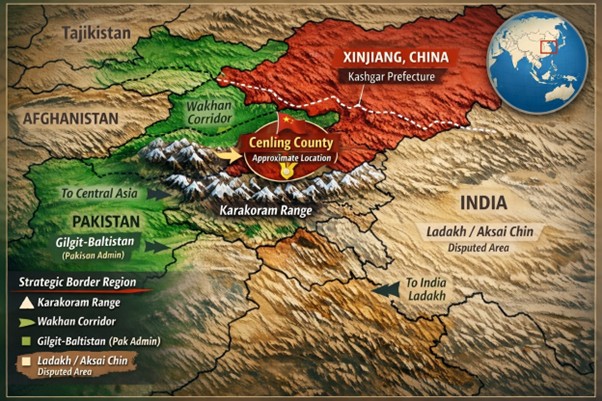
China has redrawn the map again—this time near one of Asia’s most sensitive frontiers. On March 26, 2026, Beijing officially created Cenling County in Xinjiang, its third new county since December 2024. Far from a routine administrative step, the move signals a deeper strategy to consolidate control, strengthen governance, and expand China’s presence across a critical geopolitical crossroads.
China’s western frontier has long been shaped by the intersection of geography, security, and state control. Xinjiang sits at the crossroads of South Asia, Central Asia, and western China, making it central to Beijing’s long-term border strategy. The creation of Cenling is not an isolated event. In December 2024, China established He’an and Hekang counties under Hotan Prefecture. With Cenling, Beijing has now created three new counties in just over a year, pointing to a deliberate pattern of expanding administrative control in sensitive frontier regions.
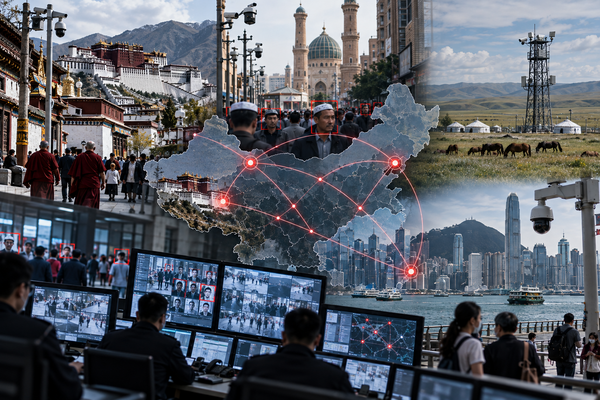
This is not just governance; it is strategy in slow motion. China’s official announcement was notably brief. It confirmed approval by the CCP Central Committee and State Council, placed Cenling under Kashgar Prefecture, and named Xinhua Township as its seat, but withheld both the rationale and exact boundaries. That silence is revealing. It suggests the true significance lies in where Cenling is located and what it enables, rather than in what was officially stated. The most compelling explanation is frontier consolidation. Administrative units like counties create governance structures, including offices, records, infrastructure planning, and local authority, embedding state presence in remote areas.
Cenling is reported to lie in southwestern Xinjiang, near the Karakoram Range, close to Pakistan and Afghanistan, and near the sensitive western sector of the India–China frontier. This region sits along routes linking China to South and Central Asia, making administrative strengthening crucial for monitoring movement, securing logistics, and expanding state reach. The area’s proximity to the Wakhan Corridor adds a further security dimension. While not officially stated, analysts have linked the move to concerns over infiltration and stability in Xinjiang’s outer frontier, a reading consistent with Beijing’s long-standing focus on internal security and control.
China’s approach reflects a broader model of bureaucratic statecraft, using governance itself as a geopolitical tool. By creating new counties, China strengthens institutional control through legal and administrative systems, expands infrastructure and planning capacity, and builds long-term operational depth in frontier zones. Positioned under Kashgar Prefecture, Cenling gains added significance because Kashgar serves as a gateway connecting China with Central, South, and West Asia. This is not expansion through force; it is expansion through administration.
For India, the issue is not just Cenling itself, but the pattern behind it. New Delhi has already protested the creation of He’an and Hekang, stating in Parliament on March 21, 2025, that parts of these areas fall within Ladakh and reaffirming that such moves do not alter India’s sovereignty claims. The concern is clear: for India, the risk is not today’s map, but tomorrow’s reality. Repeated administrative expansion could strengthen China’s practical control on the ground, influence future boundary negotiations, and reinforce Chinese claims through governance, mapping, and documentation. Cenling’s placement under Kashgar also ties it to a wider strategic geography involving Pakistan-linked corridors and regional connectivity, adding another layer of sensitivity.
China’s move also sends a wider message to the world. Geopolitical power is no longer exercised only through military means; it can also be built through administration. This reflects a shift toward mapping as strategy, governance as control, and infrastructure as influence. In modern geopolitics, control is increasingly established through systems, institutions, and permanent presence rather than visible confrontation.
If this pattern continues, several outcomes are likely. China may establish more administrative units in sensitive frontier zones, India–China diplomatic friction could intensify, scrutiny of map-based and jurisdictional changes may increase, and China’s operational depth in border regions could grow stronger. Over time, these incremental steps could reshape realities on the ground, making disputes more complex and negotiations more difficult.
Cenling County may appear to be a small administrative addition, but its significance lies in the pattern it represents. China is not simply governing its frontier; it is systematically embedding control through institutions, mapping, and administrative expansion. Cenling is not about size; it is about strategy. It reflects a broader transformation in geopolitics, where power is no longer only asserted but gradually built, documented, and normalized. In today’s world, borders are not only defended; they are administratively constructed. The real contest is no longer just over territory, but over who governs, who maps, and who institutionalizes control over time.











Leave a Reply