

China’s Communist Party opened its Fifth Plenum in Beijing on 26 October 2026. The official agenda sounds procedural. Xi Jinping presented a document on strengthening “full and rigorous Party self-governance.” The meeting runs until 29 October. It will examine discipline, corruption, political loyalty and implementation of central decisions. Yet the setting gives those words a different meaning. The Central Committee began its current term in 2022 with 205 full members and 171 alternate members. Since then, investigations, expulsions and unexplained disappearances have thinned its ranks. Analysts cited by Reuters estimate that nearly a quarter of the original leadership cohort is no longer in a position to attend.
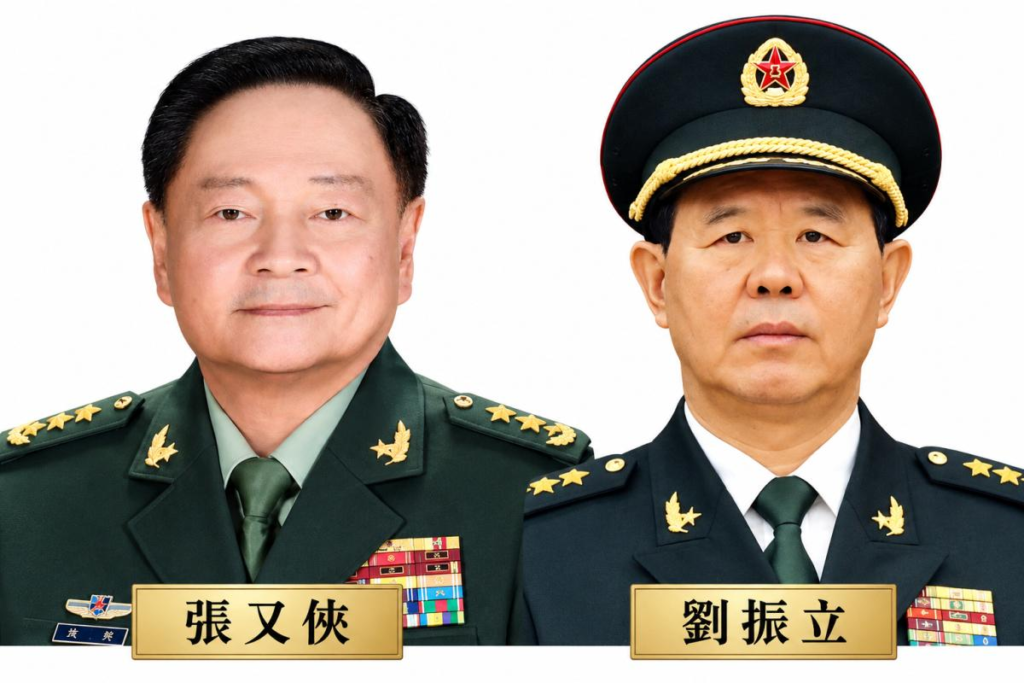
The military story is even more striking. The Central Military Commission began Xi’s third term with seven members, including Xi himself. It has since been reduced to Xi and General Zhang Shengmin after successive removals. Zhang Youxia and Liu Zhenli were placed under investigation in January and expelled from the Party and military in September. Earlier removals included He Weidong, Miao Hua and former defence minister Li Shangfu. CSIS documented more than 100 senior PLA officers who had been purged or potentially purged since 2022 by February 2026. Beijing calls this an anti-corruption struggle. Outside analysts increasingly describe it as a purge because corruption cases now overlap with questions of political loyalty, factionalism and obedience to Xi.
The Empty Seats
China’s Fifth Plenum is officially about Party discipline. But the absences around the table tell another story: years of removals have reached the Politburo, Central Committee and the highest command of the PLA.
The most important number may be the number of people missing.
Analysts estimate that fewer than four-fifths of the original 2022 Central Committee cohort may still be in a position to attend the Fifth Plenum.
The graphic below is not a literal seating chart. It visualises an outside estimate that roughly 77% of the original cohort remains available to attend.
The official explanation presents the campaign as institutional reform.
It aims to punish corruption, control abuse of power, improve implementation and maintain political discipline.
Chinese state media argues that no official should remain outside disciplinary supervision.
Analysts use this term because the campaign has removed extraordinary numbers of senior officials.
Several of those targeted were promoted by Xi himself.
Official accusations increasingly mix economic corruption with political loyalty, factional behaviour and obedience to central authority.
The clearest picture of the purge is inside China’s top command.
The Central Military Commission elected in 2022 contained Xi and six senior military leaders. Five of those six subordinates have since been removed.
This did not happen in one purge.
The 20th Party Congress elects 205 full Central Committee members and 171 alternates. A seven-person CMC is formed.
Defence Minister Li Shangfu falls from office. Investigations spread through procurement and strategic forces.
The purge moves deeper into the CMC and political command structure.
Zhang is China’s highest-ranking uniformed officer and one of Xi’s oldest military allies.
The decision leaves only Zhang Shengmin serving alongside Xi from the original CMC lineup.
Its central subject is stricter Party self-governance, discipline and long-term control of officials.
1. Is corruption genuinely widespread?
Xi’s anti-corruption campaign therefore addresses a real governance problem.
The presence of corruption does not, however, answer why some cases rise rapidly to the highest political level while others do not.
2. Has loyalty become part of the corruption test?
Xi has criticised officials who publicly follow central directives but privately resist them.
Official accusations against fallen cadres increasingly include language about political disloyalty, factional behaviour or failure to uphold central authority.
This makes the line between anti-corruption and political discipline harder to separate.
3. Why target experienced generals?
Zhang Youxia is particularly significant. He had combat experience and longstanding personal links to Xi.
His fall suggests that proximity to the leader no longer guarantees political security.
4. Does the purge remove alternative power networks?
Senior military and provincial officials build professional networks through promotions, procurement decisions and patronage.
Breaking those networks can reduce corruption.
It can also prevent any institutional bloc from becoming politically independent of Xi.
5. Why continue after more than a decade?
Beijing presents continuous discipline as evidence that the system can cleanse itself.
Critics ask the opposite question: if corruption and disloyalty keep returning after years of purges, why has the system not solved the underlying problem?
Does the purge prove Xi is powerful—or worried?
Xi has shown that even the most senior officers can be removed.
No military faction has openly resisted. The Party remains politically stable.
Repeated removals also reinforce the principle that the PLA answers to the Party, and ultimately to the CMC chairman.
Many purged officials rose during Xi’s own rule.
Removing them raises questions about the reliability of the promotion system itself.
A command structure repeatedly emptied by investigations may also lose experience, institutional memory and decision-making continuity.
Loyalty can be strengthened. Readiness can still suffer.
Those two conclusions are not mutually exclusive.
Reducing procurement corruption could improve equipment quality.
Stronger political discipline could reduce factionalism.
Newly promoted officers may be more responsive to central orders.
Senior military experience cannot be replaced instantly.
Fear of investigation may encourage officers to avoid risky decisions.
Procurement programmes and promotions can slow when decision-makers disappear.
Five signals from the Fifth Plenum
Research Base
The Fifth Plenum therefore matters for more than the disciplinary document it will approve. It offers a snapshot of a political system that has spent years removing senior people from its own ranks. Beijing presents that process as self-reform. There is evidence that corruption inside the Party and PLA has been serious. Yet the purge has moved far beyond procurement scandals. Senior officials have also faced accusations involving loyalty, factions and failure to follow central decisions. That changes the meaning of anti-corruption. It becomes a mechanism for shaping not only how officials use money, but also how they think, behave and respond to Xi’s authority.
The empty seats create the real paradox. Xi may now exercise tighter personal control than any Chinese leader in decades. At the same time, many officials removed during this campaign rose under his own leadership. The PLA illustrates that contradiction most clearly. Five of Xi’s six original military subordinates on the 2022 Central Military Commission are gone. Removing corrupt or unreliable commanders may eventually produce a cleaner force. It can also disrupt command continuity and expose a deeper problem of political trust. The question emerging from the Fifth Plenum is therefore larger than who will be purged next. How does a system built around loyalty remain effective when the leadership repeatedly concludes that the people it trusted cannot be trusted?






Leave a Reply