

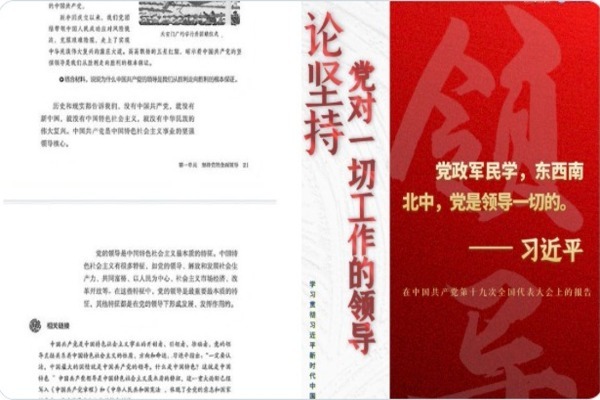
A new mandatory Grade 9 textbook in China has reportedly included a chapter titled “The Party Leads Everything” — 党领导一切. The phrase is blunt, political and revealing. For years, Beijing has insisted that its education system is simply teaching patriotism, national pride and civic duty. But this title removes the softer language. It tells students, directly and officially, that the Chinese Communist Party is not one institution among many. It is presented as the authority above school, society, law, army, government and even personal thought.
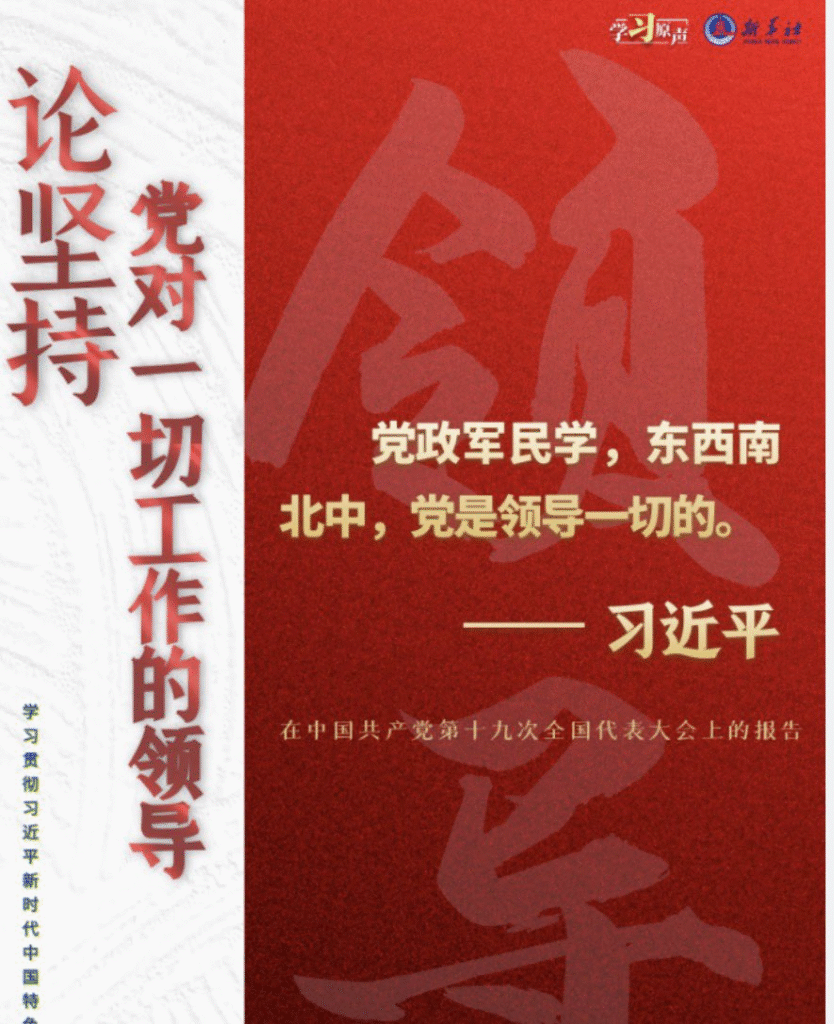
The phrase itself is not new. “The Party leads everything” became a major slogan under Xi Jinping and was written into the Communist Party constitution during the 2017 Party Congress. The full political formula says: “Party, government, military, society and education east, west, south, north and center the Party leads everything.” In simple words, there is no neutral space outside the Party’s reach.
That is why its appearance in a Grade 9 textbook matters. Grade 9 students are usually around fourteen or fifteen years old, at an age when they are preparing for major academic exams and forming their political understanding of the world. China’s nine-year compulsory education system makes schooling mandatory, so ideological content in these textbooks does not reach only a few selected students. It reaches an entire generation. China’s Ministry of Education said revised compulsory-education textbooks began being used in 2024 and would cover all grades within three years.
The title also fits a much larger trend. China’s Patriotic Education Law, passed in October 2023 and effective from January 1, 2024, requires patriotic education to uphold Communist Party leadership and strengthen national unity. It places ideology not only in schools, but also in families, public culture, cyberspace, museums and media.
This means the classroom is no longer just a place to learn history, science or literature. It is becoming a political training ground. Students are not only taught that China is their country; they are taught that loyalty to China is inseparable from loyalty to the Communist Party. That distinction is important. In a normal civic education system, students may be encouraged to love their country while still being allowed to question the government. In China’s system, the Party increasingly defines itself as the country.
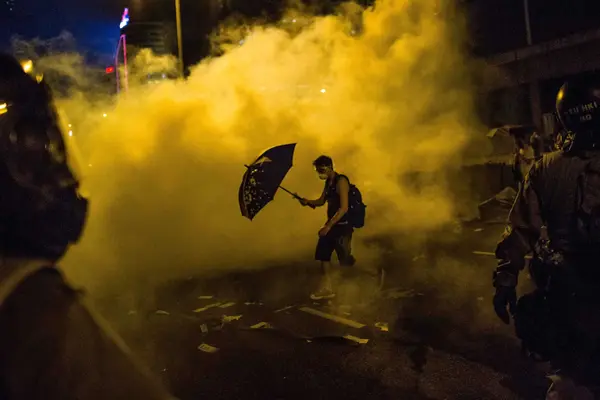
Examples are everywhere. In Hong Kong, schools have rolled out lessons on Xi Jinping Thought, national security and patriotism after Beijing tightened control over the city. Secondary students are being taught China’s political structure and Xi’s ideology as part of the formal curriculum. On the mainland, Xi Jinping Thought has been integrated into national education policy, including ideology and politics textbooks.
The message to young people is clear: political obedience is not optional; it is part of becoming a “good student” and a “good citizen.” This is how authoritarian systems reproduce themselves. They do not wait until adulthood to demand loyalty. They begin early, in classrooms, textbooks, morning ceremonies, school activities and exam language.
The chapter title “The Party Leads Everything” is therefore more than a slogan. It is a curriculum signal. It tells teachers what to emphasize. It tells students what answer is expected. It tells parents that political education is not a side subject but a central mission of the school system.
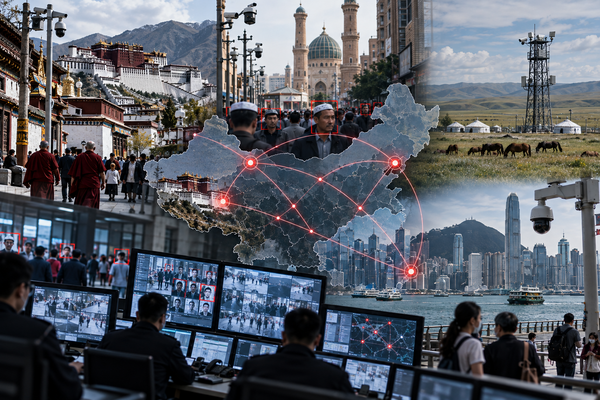
For Tibetans, Uyghurs, Mongolians, Hong Kongers and other communities under Beijing’s rule, this kind of textbook policy carries an even deeper concern. When the Party claims to lead “everything,” it also claims authority over culture, language, religion and identity. Education becomes a tool not just for learning, but for reshaping memory. Local histories can be rewritten. Minority languages can be pushed aside. Political loyalty can be placed above cultural truth.
Beijing calls this unity. Critics call it indoctrination. The difference lies in freedom. Real unity allows debate, diversity and disagreement. Indoctrination demands one correct answer before the question is even asked.
The most striking part is that China no longer seems interested in hiding this approach. The old language of “development,” “modernization” and “national rejuvenation” still exists, but now it is increasingly joined by direct statements of Party supremacy. The classroom wall, the textbook page and the political slogan all point in the same direction: the Party is not merely governing China; it wants to define reality for China’s children.
That is why this Grade 9 chapter matters. It is not just one lesson in one book. It is a window into Xi Jinping’s China a state where education is being redesigned to produce loyalty before independent thought, obedience before inquiry, and Party identity before personal conscience.









Leave a Reply