


When Compassion Is Censored
What public outrage over a horrific dog-burning case reveals about political control, Tibetan Buddhist values and the meaning of peace.
mother dog’s suffering triggered grief across China. Ordinary citizens showed compassion, demanded accountability and called for stronger protection for animals. Yet the response to their outrage raised a larger and more uncomfortable question: what happens when public conscience becomes inconvenient to political power?
The case was not only about cruelty to animals. It became a test of whether citizens could openly organise, question authorities and demand legal reform without their anger being treated as a threat to public order.
“Peace does not silence grief. Peace listens to it. Peace does not control faith. Peace protects it.
A Crime That Reached Beyond One Street
In Jieyang, Guangdong, a stray mother dog and her newborn puppies reportedly became victims of an exceptionally cruel attack. The case spread rapidly through Chinese social media, generating demands for transparency, accountability and stronger animal-protection laws.
What made the incident especially powerful was the response of ordinary people. Dog lovers did not see a disposable street animal. They saw a frightened mother and vulnerable young lives that deserved protection.
Residents, online campaigners and animal-welfare advocates refused to remain silent. Campaign material reportedly appeared on screens beyond mainland China, showing how citizens sometimes look abroad when they believe their voices are being restricted at home.

When citizens must seek attention abroad to demand justice at home, how much room does their own system leave for public conscience?
A healthy public system does not fear peaceful demands for reform. It creates transparent legal channels through which citizens, journalists and civil organisations can seek answers.
Chinese citizens and animal lovers demanded justice.
Campaigners continue to call for comprehensive national anti-cruelty protections.
Public anger can become sensitive when it develops into organised civic pressure.
The Contrast Is Not Chinese People Versus Tibetans
It would be unfair to suggest that Chinese people lack compassion. Their response to the dog-burning case demonstrates the opposite. Across China, rescuers shelter abandoned animals, residents feed street dogs, lawyers argue for stronger legislation and families treat their pets as loved companions.
The deeper contrast is not between ethnic communities. It is between compassion rising from society and political control imposed from above.
When a public campaign becomes difficult to manage, an authoritarian system may begin treating the public reaction as the problem. Online conversations can disappear, independent organisation can be discouraged and calls for accountability can be reframed as threats to stability.
This is where the story connects with Tibet. Tibetan religious, linguistic and cultural life has repeatedly been placed under political supervision in the name of unity and stability.
Two Different Visions of Power
Select a value to examine how it operates.
When power listens
Citizens can organise, journalists can investigate and campaigners can call for legal reform. Public grief becomes a source of moral responsibility rather than something that must be suppressed.
When power demands obedience
Public expression is tolerated only while it remains politically harmless. Religion, language and memory are accepted only when they remain subordinate to the state.
Buddhism Begins With the Refusal to Cause Suffering
Compassion is not decorative language in Tibetan Buddhism. It is a daily discipline. The principle of non-harm asks people to avoid unnecessary suffering and to recognise the value of life beyond human interests.
Tibetan Buddhist teachings emphasise interdependence: the belief that human beings, animals and the natural environment do not exist in isolation. Actions create consequences, and kindness toward a vulnerable being is considered part of spiritual practice.
Tibetan Buddhist monks are often seen feeding animals around monasteries, protecting injured creatures or responding gently to dogs that have learned to trust them. These moments do not mean that every Buddhist individual or institution is perfect. They express an important moral ideal:
Power should protect vulnerable life, not dominate it.
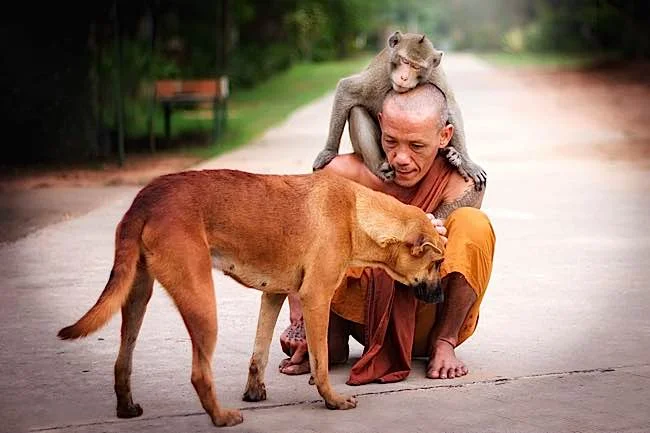
A dog approaching a monastery understands no ideology. It understands the hand that offers food, the voice that does not threaten and the place where it feels safe.
That relationship expresses something central to Buddhist peace. Peace is not simply the absence of conflict. It is practised through ordinary choices: feeding a hungry animal, protecting a helpless creature and refusing to cause needless suffering.
Harmony Imposed Through Fear Is Not Peace
The Chinese Communist Party frequently presents harmony, stability and unity as national virtues. But harmony enforced through surveillance, censorship and political obedience is not the same as peace.
Genuine peace permits disagreement. It allows citizens to question authorities, religious communities to preserve their traditions and children to learn the language of their families.
Independent rights organisations have documented restrictions on Tibetan Buddhist institutions, religious education and expressions of devotion to Tibetan spiritual leaders. Concerns have also been raised about the weakening of Tibetan-language education and the increasing use of political instruction in schools.
Religious practice cannot remain truly independent when monasteries, teachers and sacred institutions are expected to operate under extensive political supervision.
Language carries memory, poetry, spiritual teaching and family history. Weakening Tibetan-language education affects far more than classroom communication.
Tibetan religious communities argue that decisions concerning spiritual succession should be determined through Tibetan Buddhist traditions rather than by government officials.
Can a government claim to protect a religion while insisting that its most sacred decisions require political approval?


Tibet’s Freedom Is a Question of Dignity
Supporting Tibet’s right to preserve its identity does not require hostility toward Chinese citizens. Many Chinese people who demand justice for abused animals are confronting the same broad machinery of censorship and political control.
The central argument is that Tibetans should be able to protect their language, practise their religion, educate their children and shape the future of their spiritual traditions without coercive interference.
Religious freedom
Monks and communities should be able to teach and practise without compulsory political supervision.
Language rights
Tibetan children should be able to learn, read and communicate in the language of their families.
Cultural continuity
Tibetan culture should be lived freely, not reduced to a controlled display for outsiders.
Spiritual authority
Religious succession should be guided by the religious tradition to which it belongs.
The Final Question
A state can construct roads, railways, towers and surveillance systems. It can repeat the words harmony and development in official speeches. But moral leadership cannot be manufactured through propaganda.
It is revealed when a helpless animal needs protection, when citizens demand justice, when a minority seeks to preserve its language and when a religious community asks to live according to its own conscience.
Chinese citizens who demanded justice for the abused dogs demonstrated compassion. Tibetan Buddhist traditions continue to teach non-violence, responsibility and reverence for life.
The failure does not belong to ordinary people. It lies with political systems that treat independent compassion, public mobilisation and cultural autonomy as dangers.
Peace does not silence grief. Peace listens to it.
Peace does not control faith. Peace protects it.
Peace does not erase identity. Peace gives it room to live.
This is why Tibet deserves dignity, cultural freedom and the right to preserve the values that have sustained its people for generations.
Add or update citations after independently checking the latest reporting.













Leave a Reply