

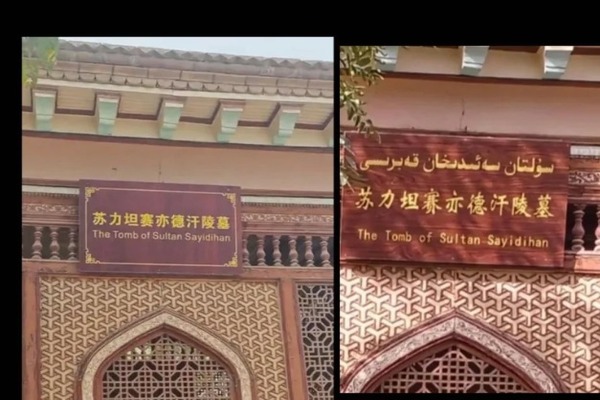
A recent visual change at the historic Tomb of Sultan Sayidihan has again drawn attention to the shrinking public presence of the Uyghur language in China’s Xinjiang region, known to many Uyghurs as their homeland. Images circulating online and reported by Uyghur-focused outlets show that earlier signage at the site, which once displayed Uyghur script prominently, has been replaced or altered. Chinese now dominates the signboard, while English appears in a limited supporting role. The absence of visible Uyghur writing has become the center of concern.
The site itself is not ordinary. The Tomb of Sultan Sayidihan carries historical and cultural meaning for Uyghurs, especially in Yarkant, a city closely tied to Uyghur memory, Islamic heritage, and regional identity. For this reason, the removal of Uyghur script from such a location is not being seen as a simple design change. To many observers, it reflects something deeper: the gradual pushing of Uyghur language out of public life.
Online reactions suggest that the change may be recent. Some netizens, responding to posts by Uyghur linguist Abduweli Ayup, reportedly said that the older sign was still visible during visits in 2025. This timeline has strengthened fears that the shift is part of a wider and accelerating policy direction rather than an isolated administrative update.
The concern comes at a sensitive moment. China’s newly adopted Ethnic Unity Law, passed in March 2026 and scheduled to take effect in July, has raised alarm among rights advocates, researchers, and minority communities. Beijing presents such laws as tools for national unity and social harmony. Critics, however, argue that the language of unity is being used to justify cultural standardization under a Han Chinese and Mandarin-centered national identity.
Language is central to this debate. For Uyghurs, their script is not just a method of communication. It carries history, faith, poetry, family memory, local belonging, and cultural continuity. When a language disappears from schools, offices, roads, museums, and monuments, a community does not only lose letters on a board. It loses public recognition of its existence.
Reports over recent years suggest that the decline of Uyghur visibility has happened in stages. First, Uyghur-medium education came under growing pressure, with Mandarin increasingly prioritized in classrooms. After 2017, many public services and official spaces reportedly reduced the use of Uyghur. Now, critics say the process has moved further into the visual landscape itself: street signs, institutional boards, historic sites, and cultural markers.
This creates a sharp contradiction. Some Uyghur heritage sites are preserved, restored, or promoted for tourism. Visitors may see architecture, tombs, bazaars, and curated cultural displays. But rights groups argue that this version of culture is carefully managed. It presents Uyghur identity as a museum object, while living expressions of that identity—language, religion, education, and community practice—face restrictions.
The change at the Tomb of Sultan Sayidihan therefore carries symbolic weight. A historic Uyghur place can remain physically standing, yet its Uyghur voice can be removed from public view. The building may survive, but the meaning attached to it can be reshaped by the state.
This is why the disappearance of Uyghur script from public spaces matters. It signals who is allowed to belong visibly and whose identity must be reduced, translated, or hidden. If the new legal framework strengthens Mandarin-first policies, the decline of Uyghur writing in everyday life may become even more widespread.
The issue is not only about signage. It is about whether a people can see their own language in their own homeland. For Uyghurs, every removed script is more than a missing word. It is another sign of cultural erasure taking place in plain sight.











Leave a Reply