

Beijing turns cybersecurity into a visible market ranking
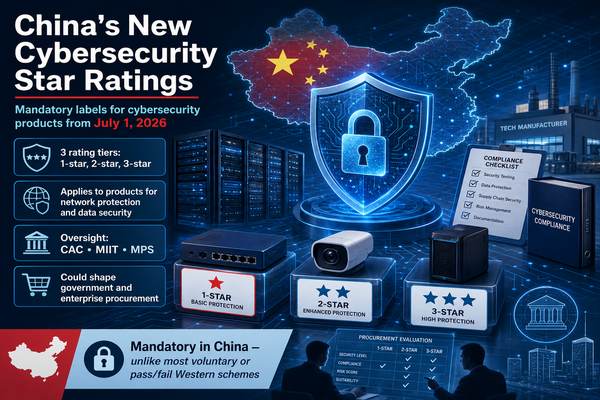
China’s new cybersecurity labeling system marks a major step in turning product security from a technical back-office issue into a public-facing market signal. From July 1, 2026, China’s Measures for Administration of China Cybersecurity Labels will take effect, creating a three-tier label system for products with internet connectivity. The measure was jointly issued by the Cyberspace Administration of China, the Ministry of Industry and Information Technology, and the Ministry of Public Security. Official Chinese reporting says the aim is to improve product cybersecurity capability, protect consumer rights, and safeguard network security and public interest.
One star, two stars, three stars: what the ratings mean
The label will rank products by cybersecurity capability. One star represents the basic level, two stars represent the enhanced level, and three stars represent the leading level. Chinese official reporting describes the basic level as requiring products to meet core national security requirements, including avoiding weak passwords or universal default passwords, maintaining vulnerability-management mechanisms, dynamically fixing vulnerabilities, and keeping software updated. Enhanced and leading levels are meant to show stronger, more advanced cybersecurity capability.
This matters because many internet-connected products—smart cameras, routers, wearables, smart locks, home appliances, industrial IoT terminals—can become entry points for cyberattacks. A weakly protected camera or router is not just a consumer problem; it can become part of botnets, surveillance networks, data theft chains, or industrial disruption pathways. By making security visible through a label, China is trying to create a system where consumers, companies, and government buyers can compare products before purchase.
Important correction: not simply “all cybersecurity products”
One careful point is necessary. Some summaries describe the rule as applying to “all cybersecurity products sold in China,” but official Chinese coverage says the measure applies to products with internet connectivity functions, with specific implementation categories to be managed through a product catalogue. Some Chinese industry reporting also notes that network critical equipment and specialized cybersecurity products are handled under a separate certification and testing system, not necessarily under this new label regime.
Another key distinction is that official Xinhua reporting says producers participate according to a voluntary principle, while encouraging producers to improve security capability and label products, and encouraging consumers to prefer labeled products. However, even if the scheme is formally voluntary at the start, it may become commercially unavoidable. Once government departments, state-owned enterprises, banks, telecom operators, or large platforms begin preferring labeled products, the label can function like a de facto procurement requirement.
Why Beijing is doing this now
China’s move fits into a wider global trend. Governments are increasingly treating connected devices as national-security infrastructure, not just consumer electronics. The United States has promoted the Cyber Trust Mark as a voluntary label for smart devices, while the European Union’s Cyber Resilience Act takes a broader regulatory approach to digital-product security. China’s system differs by using a visible tiered star ranking, which can turn security compliance into a competitive hierarchy rather than a simple pass/fail mark.
For Beijing, the label serves three purposes. First, it gives consumers a simplified security signal. Second, it pushes manufacturers to design security into products earlier. Third, it gives regulators a new lever over connected-device markets. The involvement of CAC, MIIT, and MPS also shows that China views cybersecurity as a combined issue of internet governance, industrial policy, and public security.
Impact on manufacturers
For Chinese manufacturers, the system may become a branding opportunity. A three-star label could help domestic firms market their products as safer, more mature, and more suitable for government or enterprise use. For firms already aligned with Chinese standards, this may strengthen their competitive position.
For foreign manufacturers, the impact is more complicated. They will need to understand whether existing global certifications, internal security testing, or foreign compliance frameworks can support a Chinese label application. The first challenge is regulatory clarity: the exact standards, testing procedures, and product categories will depend on implementation rules and catalogues. China Briefing notes that companies should monitor CAC, MIIT, and related platforms for catalogue releases because the first product catalogue will determine which product categories face registration or testing earliest.
This could create new compliance costs. Manufacturers may need Chinese-language documentation, testing reports, local testing partners, vulnerability-management evidence, software update policies, and possibly product adjustments for the Chinese market. Smaller vendors may find the process burdensome, while large companies may absorb it as part of market-entry cost.
Procurement power: the real pressure point
The most important effect may not come from consumers but from procurement. In China, government agencies, state-owned enterprises, critical infrastructure operators, education systems, hospitals, and public-security bodies often follow state-backed technical signals closely. If a two-star or three-star label becomes preferred in tenders, companies without labels may be locked out of high-value markets.
This creates a powerful incentive: even a formally voluntary label can become mandatory in practice. The star system may also divide the market. Low-cost products may settle for one star, while enterprise-grade and government-grade products will compete for higher ratings. Over time, the label could become a visible marker of political and technical trust.
Strategic meaning
At one level, the measure is a reasonable response to real cybersecurity risks. Weak default passwords, poor patching, and insecure IoT devices are global problems. A label can help raise baseline security.
But in China’s system, cybersecurity regulation is never purely technical. It is also linked to data control, supply-chain supervision, market access, and state security. The label gives Beijing another mechanism to shape which products are trusted, which vendors are favored, and which technical standards define market legitimacy.












Leave a Reply