

Zhang Shengmin’s meeting with Russia defence minister reveals two stories at once: Beijing and Moscow are expanding military coordination, while Xi Jinping’s own supreme command has been hollowed out by purges.
China’s most powerful active general met Russian Defence Minister Andrei Belousov in Beijing on 3 November. General Zhang Shengmin called for stronger strategic communication and deeper military trust between China and Russia. He also proposed better cooperation mechanisms and new areas of practical cooperation. Belousov responded with support for closer strategic consultations, military education and technological cooperation. The meeting came at an important moment. Beijing and Moscow already conduct joint exercises, maritime patrols and senior-level military exchanges. Both governments now describe their defence relationship as increasingly important to regional and global security.
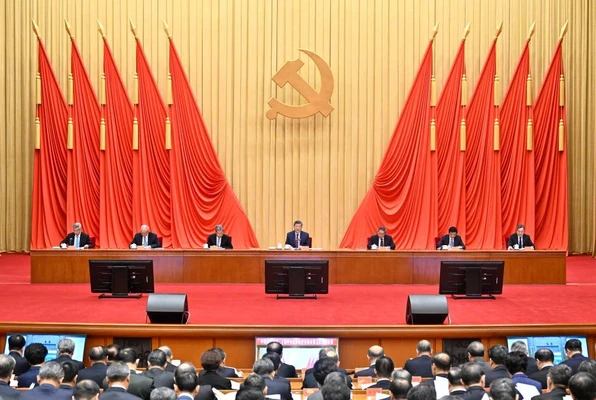
But Zhang’s position makes this meeting unusual. China’s Central Military Commission began its current term in 2022 with seven members. Five have since been removed or expelled during Xi Jinping’s anti-corruption campaign. Only Xi and Zhang remain active on the supreme command body. Zhang Youxia, He Weidong, Li Shangfu, Liu Zhenli and Miao Hua have all fallen from the original lineup. Zhang Shengmin has moved in the opposite direction. He became CMC vice chairman in 2025 and joined the Communist Party Politburo last week. China is therefore strengthening strategic communication with Russia through a military hierarchy whose very top has become dramatically narrower.
Two Men at the Top.
One Message to Moscow.
China is expanding strategic military communication with Russia while its own supreme military command has been reduced by an extraordinary purge.
Belousov was not simply meeting another Chinese general.
Zhang Shengmin now occupies an unusually concentrated position. He is the only active uniformed member of China’s supreme military command beneath Xi Jinping.
Xi and Zhang are the only active members of the top CMC committee created in 2022. Beneath them, China’s military bureaucracy, theater commands, services and CMC functional organs continue to operate. The purge has hollowed out the supreme leadership layer, not abolished the command system.
Who actually carries a message from Xi to a foreign military?
CCP General Secretary · President · CMC Chairman
Sets the political and strategic direction.
Leader-level agreements with Vladimir Putin begin here.
CMC Vice Chairman · Politburo Member
Represents the military at the highest strategic level
beneath Xi and transmits central guidance.
Conducts minister-to-minister defence diplomacy and represents China in many foreign military engagements. He is not currently an active member of the CMC.
Manages and coordinates foreign military exchanges, consultations and cooperation across the PLA.
Translate strategic intent into planning, readiness, training requirements and coordination.
Conduct joint exercises, patrols, deployments and military exchanges.
The CMC exercises unified command over China’s armed forces.
It decides military strategy and operational guidance.
Xi chairs this structure directly.
Dong Jun remains China’s defence minister.
The ministry performs an important foreign-facing role.
But it does not command the PLA in the way many foreign defence ministries command their armed forces.
What does “strategic communication” actually mean?
Military cooperation is repeatedly described as flowing from agreements reached by the two presidents.
Senior leaders exchange views on regional security, global military developments and areas of mutual concern.
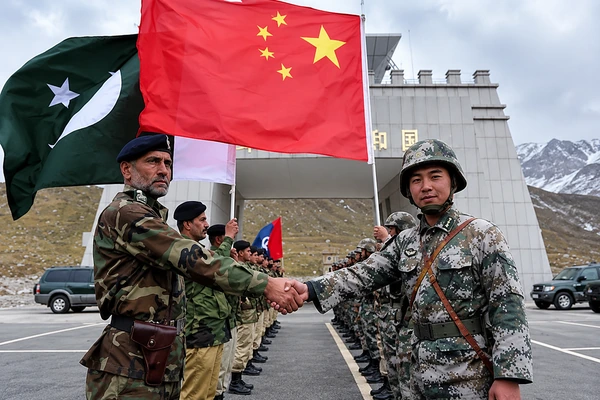
China and Russia conduct joint naval exercises, maritime patrols and other forms of coordinated training.
Regular consultations help cooperation survive changes in personnel and international conditions.
Belousov specifically mentioned expanding cooperation in military education.
Russia’s readout also highlighted technological innovation as a field for further practical cooperation.
2026 has already built a dense China–Russia military contact chain.
Both sides call for stronger strategic consultations, improved communication mechanisms and deeper cooperation.
The defence ministers discuss bilateral military relations and agree to deepen practical cooperation.
China’s Defence Ministry says both leaders agreed to strengthen military trust, improve mechanisms and expand joint exercises and maritime and air patrols.
Chinese and Russian forces train in joint reconnaissance, air and missile defence and maritime operations. They then transition into a joint maritime patrol.
His political authority rises after years spent overseeing discipline and anti-corruption inside the PLA.
The engagement moves China–Russia military diplomacy from the defence-minister level to China’s surviving top uniformed CMC leader.
External coordination is expanding while internal command is shrinking.
China and Russia are institutionalising consultations.
Joint naval activity continues.
Military education and technology are entering the cooperation agenda.
The two sides increasingly coordinate around shared strategic interests.
Five of seven original CMC members are gone.
The Joint Staff leadership has been disrupted.
Experienced commanders have disappeared from the supreme decision-making layer.
Xi relies on an unusually narrow top command.
Moscow brings something Beijing does not have: recent large-scale combat experience.
Russia’s armed forces have accumulated extensive experience from the war in Ukraine. China has modernised rapidly but has not fought a comparable modern conventional war.
That does not mean China is simply copying Russia. Russian battlefield experience includes both useful lessons and costly failures.
It does mean that military education, training and technical exchanges with Russia deserve close attention.
Does a two-member CMC mean China’s military is paralysed?
The CMC’s top committee has been dramatically reduced, but the wider military bureaucracy continues functioning.
Theater commands, service headquarters and CMC departments still exist and execute military policy.
The real concern is leadership continuity, concentration of authority and the loss of senior experience.
Why is Zhang Shengmin so important now?
He is also now a Politburo member.
His rise places a former military-discipline chief at the centre of both military command and Party politics.
Where does Defence Minister Dong Jun fit?
He talks directly with foreign defence ministers and represents China at international meetings.
But China’s Defence Ministry does not sit above the PLA operational chain.
Real command authority remains with the CMC.
Are China and Russia becoming a formal military alliance?
China’s official position describes the military relationship as non-alliance, non-confrontation and not directed against a third party.
Their practical military cooperation is nevertheless becoming broader and more regular.
Does Russia’s Ukraine experience benefit the PLA?
Russia can share experience involving drones, electronic warfare, logistics, air defence, battlefield adaptation and high-intensity operations.
But Russian experience also contains major failures. China can study both successes and mistakes.
Could the purge itself weaken Chinese military diplomacy?
Fewer senior decision-makers may make authority clearer.
But repeated investigations can remove institutional memory and make remaining officers more cautious about taking initiative.
Zhang’s rise may partly be designed to restore a clear political centre after the upheaval.
What should analysts monitor next?
The central paradox is difficult to miss. China wants stronger strategic communication with Russia, more military trust and additional practical cooperation. Yet Xi is pursuing that external coordination through the smallest active supreme command of his current era. Five of the seven officials appointed to the Central Military Commission in 2022 have fallen. Only Xi and Zhang remain. That does not mean the PLA has stopped functioning. Its services, theater commands and large military bureaucracy continue to operate. But it does mean that authority at the top has become unusually concentrated.
Zhang Shengmin therefore matters for reasons that go far beyond his meeting with Belousov. He rose through the military discipline system that helped enforce Xi’s anti-corruption campaign. He is now a CMC vice chairman and the Politburo’s sole military representative and is also becoming one of Beijing’s most important channels for strategic military dialogue abroad. Russia offers China exercises, consultations and access to a military with recent battlefield experience. China offers Russia a powerful strategic partner with rapidly modernising forces. But behind that growing partnership sits a question Beijing cannot completely hide: how confidently can China expand military coordination abroad while still rebuilding trust and leadership continuity inside its own supreme command?





Leave a Reply