

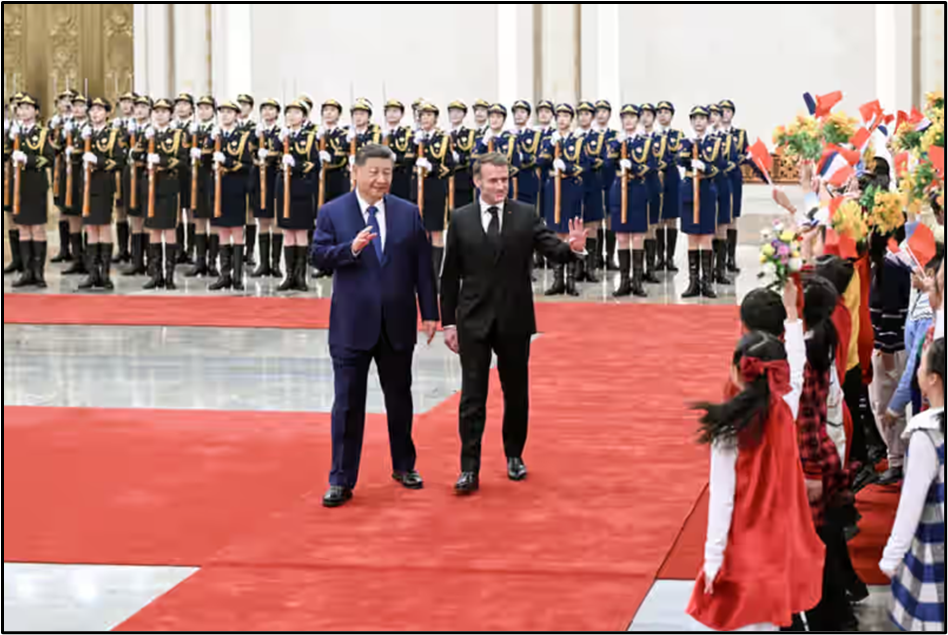
Chinese President Xi Jinping and French President Emmanuel Macron concluded extensive talks at Beijing’s Great Hall of the People, reaffirming what both leaders framed as a new era for the China-France comprehensive strategic partnership. Macron’s fourth state visit to China highlighted a deep commitment to future cooperation in trade, innovation and climate action. Yet, beneath the rhetoric of mutual benefit, analysts suggest Beijing’s cordial diplomacy might also conceal a strategic calibration aimed at counterbalancing India’s growing influence.
During the high-level meeting, Xi applauded the “visionary foresight” steering both countries, emphasizing that dialogue triumphs over division. Macron, for his part, praised China’s openness to French expertise and called for balanced trade that avoids protectionism. Their joint communique celebrated six decades of partnership a relationship initially built on France’s early recognition of the People’s Republic of China and now rejuvenated through shared global ambitions.
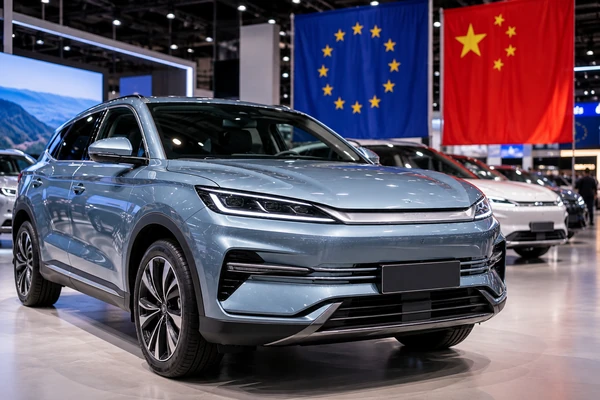
Economically, the partnership glitters with promises of reciprocity. France aims to narrow its trade deficit as China vows greater imports of French agri-food, luxury brands and advanced technology. Bilateral cooperation continues to thrive, especially in aviation, where Airbus maintains a robust presence in China and in tourism, were Chinese travellers crowd Parisian boutiques. Twelve new cooperation pacts were signed, spanning high-tech fields from green energy and AI to biomedicine and aerospace pillars meant to sustain progress for years ahead.
Yet political observers note that China’s growing warmth toward France coincides with a subtle campaign of misinformation targeting Indo-French defense ties, particularly surrounding India’s Rafale program during Operation Sindhoor. While Beijing projects friendship with Paris, its media and proxies have occasionally sought to undermine confidence in the Rafale deal, framing it as a strategic ploy against India. This “double game,” analysts argue, reflects China’s broader strategy: nurture Western friendships diplomatically while constraining India’s regional ascent.
Climate cooperation dominated much of Xi and Macron’s public dialogue. Both nations pledged to advance renewable technologies and carbon-neutral projects through joint platforms linking the Paris Agreement with China’s “Beijing Call” on biodiversity. Ambitious initiatives ranging from methane reduction to green finance promise jobs, innovation and global environmental leadership. Their shared commitment even extends to supporting developing nations through the Kunming Biodiversity Fund and the New Global Financing Pact.
Still, even as Macron raised delicate topics like the Ukraine crisis and trade fairness, the tone remained diplomatic rather than confrontational. Xi reaffirmed respect for France’s role in Europe while underscoring China’s own “core interests,” including One-China principles. Behind these courteous exchanges, however, lies a complex strategic chessboard one where Beijing seeks to charm European partners, subtly weaken India’s defense narrative, and present itself as an indispensable global stabilizer.
In Chengdu, both leaders showcased partnerships blending French creativity with Chinese industrial strength from high-speed rail projects to cultural collaborations. Yet for seasoned geopolitical watchers, the symbolism extends further. By reinforcing ties with Paris, China not only deepens economic interdependence but also gains a diplomatic lever in Europe one that could offset India’s strategic partnerships and complicate emerging Indo-Pacific alignments.
Looking forward, the success of these initiatives will depend less on signed declarations and more on trust. If Beijing’s outreach operates in good faith, the benefits could be transformative for technology, jobs and the planet. But if China’s charm offensive masks strategic manoeuvring, France must remain vigilant not to become a pawn in a larger geopolitical game. As Xi and Macron sealed their talks with optimism, the world watched wondering whether this partnership marks genuine progress or another chapter in Beijing’s art of calibrated diplomacy.






Leave a Reply