

By the end of this year, China’s far-western Xinjiang region will unveil the world’s longest expressway tunnel the Tianshan Shengli Tunnel, a 22.13-kilometer engineering marvel carved through the snow-clad Tianshan Mountains. This record-shattering project, part of the Urumqi–Yuli Expressway, promises to transform one of China’s toughest travel routes into a smooth, high-speed link shrinking a treacherous, hours-long mountain journey into a 20-minute drive.

For China, officials present the project as a symbol of progress a safer, faster route for families, truckers and tourists alike. But its implications stretch far beyond convenience. The tunnel adds a crucial link knitting together Xinjiang’s divided north and south, both economically and strategically, while reinforcing China’s broader ambitions under the Belt and Road Initiative (BRI).
The Tianshan Shengli Tunnel pierces one of Asia’s most inhospitable landscapes. A range known for avalanches, freezing conditions and high-altitude engineering challenges. Built in just over four years using advanced tunnel-boring technology, its completion symbolizes Beijing’s growing mastery in mega-infrastructure the same prowess that has produced world-leading bridges, railways and pipelines across China’s rugged terrain.
The project underscores how infrastructure has become China’s preferred tool to integrate remote regions like Xinjiang with national and global trade arteries. Once operational, the new expressway will trim travel time between Urumqi, the bustling provincial capital, and Korla in the south from seven hours to under three, strengthening year-round transport and ensuring that snow or landslides no longer paralyze regional logistics.
Beyond civilian mobility, the tunnel enhances Xinjiang’s position as China’s gateway to Central Asia. The region already handles billions in trade annually and forms a critical land bridge for BRI routes connecting China with Kazakhstan, Kyrgyzstan and onward to Europe. With smoother north-south movement, goods can reach border crossings faster lowering logistics costs and pulling more freight into China-controlled corridors.
The new tunnel also improves military mobility across China’s western frontier. The People’s Liberation Army (PLA) can now shift troops, fuel and equipment from northern garrisons to southern bases in hours, bypassing risky mountain passes. This logistical fluidity enhances China’s operational readiness near sensitive zones, including the borders with India, Tajikistan, and Afghanistan.
The infrastructure’s dual-use potential civil and defense fits Beijing’s long-standing pattern, roads that connect farmers and freight also quietly serve the army. In fact, much of China’s western infrastructure follows this twin-purpose design, ensuring that development aligns seamlessly with strategic depth.
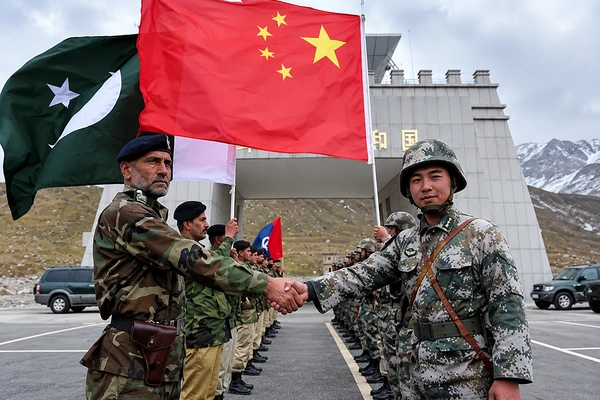
The Tianshan Tunnel doesn’t just link Xinjiang internally, it meshes with a continental supply grid under China’s Belt and Road Initiative. Projects like Pakistan’s $62 billion China-Pakistan Economic Corridor (CPEC) and Central Asia’s network of pipelines and highways all flow back to Xinjiang as a land logistics hub.
Together, these routes aim to redirect global trade and energy supply lines toward China’s sphere of influence reducing dependence on maritime chokepoints like the Malacca Strait. Each new road or tunnel strengthens Beijing’s leverage over cross-continental trade and deepens its economic reach into resource-rich neighbours. For country like India, the Tianshan project does not spark an immediate military concern it sits hundreds of kilometres from Indian borders. But strategically, it fits into a pattern that tilts western Asia’s logistics map toward Chinese control.
The Tianshan Shengli Tunnel is more than a transportation project. It’s a symbol of how Beijing uses infrastructure to fuse economic, social and strategic goals. Every kilometre built in Xinjiang extends not only China’s domestic cohesion but also its influence over the corridors connecting Asia’s heartland to Europe and the Middle East. For regional rivals, it’s a reminder that in Asia’s new great game, influence will flow as much through infrastructure as through diplomacy.





Leave a Reply