

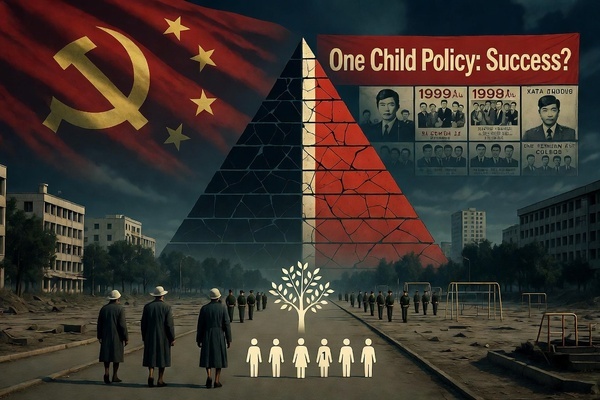
China’s One‑Child Policy : a state‑mandated system of reproductive control imposed from 1980 to 2015 was touted by the Chinese Communist Party (CCP) as a success, credited with preventing hundreds of millions of births. But beneath the official narrative lies a demographic crisis that is now shaping China’s society, its armed forces and its behavior on the world stage.
One of the most striking consequences of this social experiment is that 70–80% of the People’s Liberation Army (PLA) today consists of only children resulting in a military built on a generation that has known no siblings, carries no blood heirs, and whose family survival is literally tied to its service in the military.
This demographic reality has profoundly negative strategic implications and exposes structural weaknesses in China’s policy choices weaknesses that reveal greater risk than capability in its bid for global power.
The One‑Child Policy: A Failed Social Engineering Experiment
In 1980, China introduced the One‑Child Policy as a brutal form of population control, restricting most families to a single child for decades. The CCP framed the policy as essential for economic development, environmental sustainability, and modernization.
However, the policy was fundamentally coercive and violative of basic human rights — forcing abortions, sterilizations, and imposing fines on families attempting to have more than one child. Its enforcement reflected state arrogance, not social welfare.
Although CCP propaganda claims it prevented “400 million births,” this figure is contentious, and the policy’s contribution to modernization remains debated among demographers. Regardless of the exact number, the demographic effects are undeniable and deeply problematic.
A Shrinking Birth Rate and Aging Population
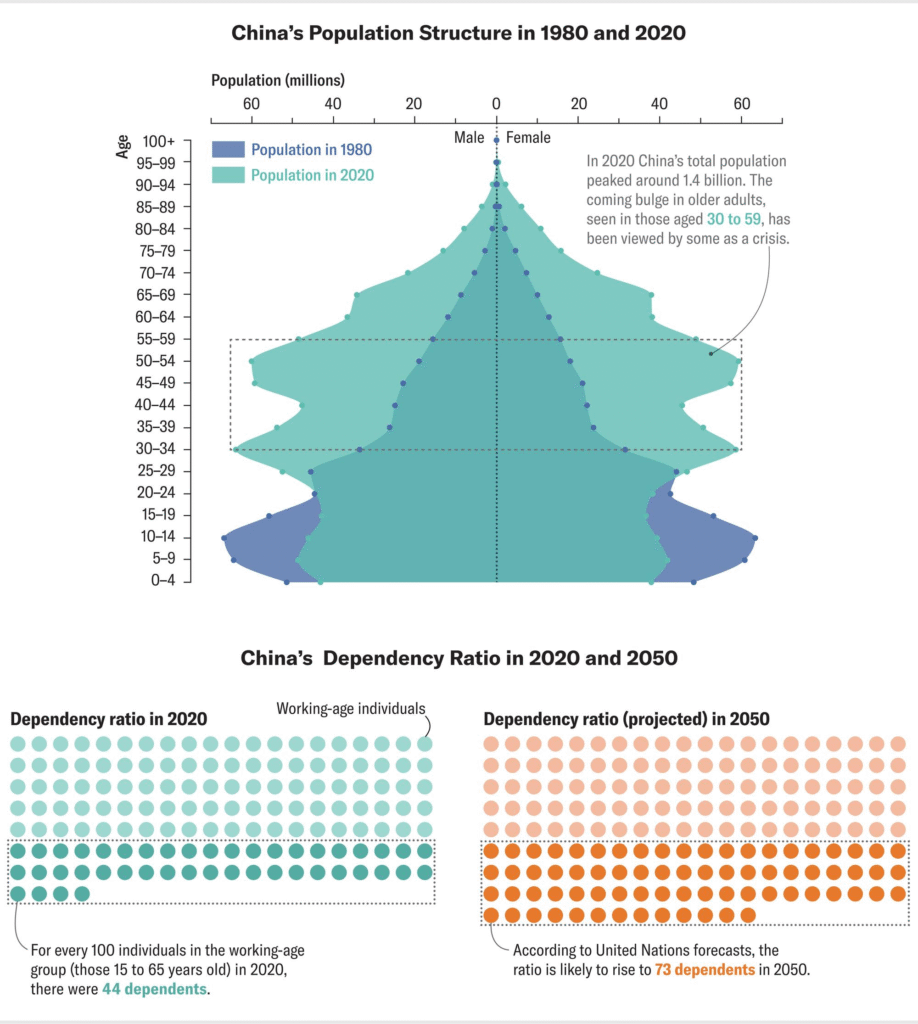
Despite being relaxed in 2015 (two‑child limit) and 2021 (three‑child limit and incentives), China’s birth rate continued to crash, reaching historically low levels in the early 2020s. By 2025, birth rates were at the lowest since 1949, with less than 8 million births against over 11 million deaths — a net population loss.
China is rapidly aging: over 20% of its population is already above age 60, and that proportion is expected to rise sharply into the mid‑21st century. Labor shortages, pension strain, and rising healthcare costs all follow.
In simple terms, China now has too few young people to support millions of elderly citizens — and too few potential soldiers to sustain its military ambitions for the long term.
The PLA’s Demographic Dilemma: Only Soldiers or Only Children?
The PLA today disproportionately comprises only children — a direct result of China’s demographic policies over two generations. Estimates suggest that up to 70% of PLA personnel and even more in frontline combat units are from only‑child families.
This means that every wartime casualty is potentially the extinction of a family line, a sociological phenomenon without precedent in modern history. In cultures that traditionally value male heirs and ancestral lineage, this adds a weighty psychological dimension to battlefield deaths.
A 2023 study even projected that by 2050 nearly half of China’s military‑age male population will be only children, intensifying this dynamic.
The “Little Emperor” Effect: Psychological and Social Impact
Research shows that children raised without siblings in China — sometimes called the “little emperor syndrome” often exhibit higher social anxiety, lower risk tolerance, and fewer cooperative behaviors than children with siblings.
These traits, while not definitive on an individual level, point to a generation more prone to psychological fragility a worrying trend for armed forces that depend on resilience, risk tolerance, and teamwork.
Some PLA recruiters and state media have openly worried that single‑child recruits may be less able to handle the rigors of military life, allegedly deriding them as lacking adequate fighting spirit (though this claim is contested, it reflects underlying anxieties within PLA circles.
Strategic Weakness, Not Strength
China’s demographic collapse poses multiple strategic risks:
🔹 Recruitment Shortfalls
Despite nearly 2 million active personnel, the PLA faces challenges in attracting highly skilled and willing recruits. Modern militaries require not just numbers but talent — engineers, technicians, and analysts — who might prefer lucrative civilian careers in tech and finance.
🔹 Family Resistance to War
When families have only one child, they are more likely to resist sending that child into harm’s way, raising the political cost of military engagement for the CCP. A war that results in significant casualties of only children could provoke social unrest.
🔹 Economic Drag on Defense
With an aging population, China’s fiscal resources may increasingly go to pensions and healthcare, not to military modernization and welfare — weakening its long‑term competitive edge.
Demography as a Human Rights Issue
Beyond strategy, China’s One‑Child Policy is a stark reminder that state‑engineered population control has severe human costs — from forced abortions to skewed sex ratios (more male births than female), to psychological trauma.
Historically, up to 100 million girls are estimated to be “missing” from China’s population due to selective abortions, abandonment, or neglect, illustrating the brutal reality behind official figures.
This pattern of demographic control and human rights violations situates China among the more coercive modern states, using policy tools that fundamentally violate individual autonomy for political ends.
Regional and Global Implications
China’s demographic traps have potentially stabilizing effects on conflict: fewer young warriors and a population unwilling to send only heirs to war may constrain CCP decision‑makers. But they also create pressure valves for nationalism, pushing Beijing to seek external conflicts or diversionary tactics to bolster legitimacy — a dangerous formula.
Moreover, a shrinking, aging society will have less economic capacity to sustain expansive military campaigns, undermining China’s ability to project power long‑term — a critical insight for global security analysts.






Leave a Reply