

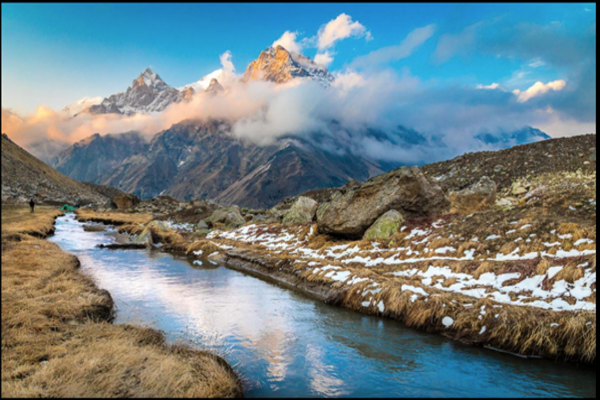
High in the remote Kumaon Himalayas of Uttarakhand, at an altitude of nearly 5,346 meters, rises a mountain known in local tradition as Somdhara, located near the coordinates 30°52’02” N, 80°00’35” E. Nestled close to the frontier between India and Tibet, this peak is more than a geographical landmark; it is a place where nature, spirituality, history, and mythology merge into a timeless Himalayan identity. The name itself comes from the Sanskrit words Som meaning moon and Dhara meaning stream, creating the poetic image of a celestial current of cool lunar energy descending from the snowy heights into the valleys below. In the silence of these rugged mountains, Somdhara stands as a symbol of purity, endurance, and spiritual stillness.
The landscape surrounding Somdhara is among the most pristine in the Indian Himalayas. Here, the air is thin, the winds are sharp and vast stretches of snow and rock remain untouched by the rush of modern civilization. The peak forms part of the Great Himalayan Range and contributes significantly to the region’s fragile ecosystem. Seasonal snowmelt and glacial streams originating from these heights eventually feed tributaries of the Kali and Gori Ganga rivers, which sustain life far downstream. For much of the year, Somdhara remains wrapped in snow that reflects sunlight with a silvery glow, giving the mountain an ethereal beauty reminiscent of moonlight itself. The peak appears as a silent bridge between the green valleys of Kumaon and the cold, expansive plateaus of Tibet.
The spiritual significance of Somdhara is deeply rooted in ancient Indian philosophy. In Vedic tradition, the moon represents calmness, healing energy and the divine nectar of immortality known as amrita. Somdhara is therefore imagined not merely as a mountain of ice and stone, but as a sacred reservoir of cosmic coolness and purity. The streams flowing from its slopes are seen as more than physical water; they symbolize cleansing and renewal. Unlike the scorching heat and restlessness of the plains, the high Himalayas offer an atmosphere of profound tranquillity. For centuries, sages and seekers have believed that such isolated landscapes create the perfect environment for meditation, reflection and spiritual awakening.
The broader region of Kumaon has been a theatre for India’s history and spiritual evolution for millennia. It has long served as the primary gateway for pilgrims traveling from the plains to the sacred Mount Kailash and Lake Mansarovar. Generations of travelers crossed these rugged terrains in search of spiritual fulfilment. During the reigns of the Katyuri kings between the 7th and 11th centuries and later under the Chand dynasty, the high Himalayan peaks were revered as sacred guardians of the land. Mountains, rivers, forests, and streams were treated with deep respect, ensuring that remote regions like Somdhara remained protected not just by geography, but also by faith and tradition.
The Himalayan passes near Somdhara were once vibrant corridors of trade and cultural exchange. Communities such as the Bhotias travelled across these routes carrying salt, wool, silk and grains between India and Tibet. The Lipulekh Pass, located in the vicinity, was the primary door for the trans-Himalayan trade and pilgrimage. Through centuries of interaction, Indian Vedic traditions and Tibetan Buddhist beliefs naturally blended in these highlands. Monasteries, shrines, folk songs and oral traditions preserved a shared spiritual culture shaped by the mountains themselves. The Himalayas became not only a physical boundary but also a meeting ground of civilizations.
During the British colonial era, the Kumaon Himalayas gained strategic and scientific importance. The Great Trigonometrical Survey of India sought to meticulously measure the sub-continent. Because these remote borderlands were difficult for European surveyors to access, Indian explorers known as “Pundits” were secretly trained and sent into the high Himalayas disguised as traders or pilgrims. Among the most celebrated of these explorers was Nain Singh Rawat, whose remarkable journeys helped map much of Tibet and the surrounding mountain ranges. For colonial cartographers, peaks like Somdhara marked the outer edges of the known world, standing between the British Empire and the mysterious lands beyond the Himalayas.
In Indian philosophical thought, mountains often symbolize the higher state of consciousness, while watersheds represent sacred points of transition. Somdhara embodies both ideas. It is a place where snow transforms into rivers and where silence transforms into spiritual insight. The mountain represents a realm untouched by the distractions of ordinary life. If the Himalayas are considered the “mind” of the earth, then Somdhara may be seen as the point where that mind reflects the cool clarity of the moon pure, serene, and eternal.
Today, Somdhara also stands as a reminder of the environmental challenges facing the Himalayas. Rising global temperatures are accelerating glacial melt across the region, threatening water systems that support millions of people in northern India. The rivers nourished by these mountains sustain agriculture, forests, wildlife, and entire civilizations downstream. The ecological influence of the region extends far beyond the high peaks, supporting biodiversity across the Nanda Devi Biosphere Reserve and even influencing ecosystems near Jim Corbett National Park. Protecting these fragile watersheds has become essential not only for the Himalayan communities but for the broader ecological balance of the subcontinent.
For trekkers and adventurers, the journey toward Somdhara is both physically demanding and spiritually moving. The harsh winds, icy terrain, and immense solitude test human endurance, yet many travelers describe the experience as deeply transformative. In these remote heights, where the modern world fades into silence, one feels a rare connection with nature and with the timeless rhythms of the earth. Somdhara continues to inspire those who seek not just adventure, but inner stillness and a deeper understanding of the natural world.
Ultimately, Somdhara remains a living symbol of how Indian civilization has always woven together geography, spirituality and poetry. Through centuries of pilgrimage, trade, exploration, and ecological change, the mountain has endured as a sacred presence in the Kumaon Himalayas. Its waters continue to flow from the frozen heights, carrying with them the memory of ancient traditions and the enduring message that humanity and nature are inseparably connected.
















Leave a Reply