

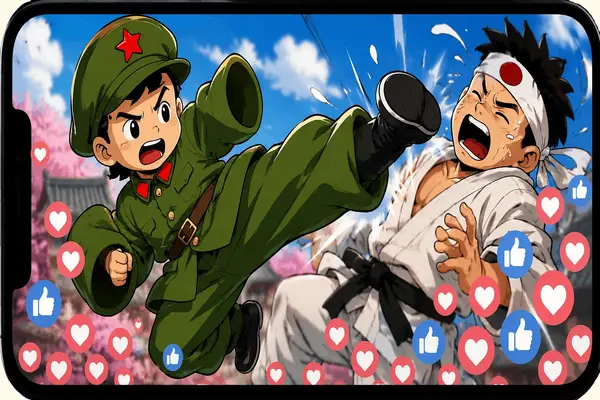
In recent years, Chinese social media has become a startling lens into the mechanics of modern nationalism, particularly in the context of historical grievances with Japan. What might appear as harmless micro-dramas or playful online skits have, in fact, evolved into a sophisticated viral engine, normalizing xenophobia and shaping the perception of youth toward historical and contemporary Japan.
One of the most striking examples is the content that blends humor, dramatization, and historical allusions in ways that are designed to engage viewers while reinforcing nationalist sentiment. Personal accounts, once limited to private family interactions, have exploded in reach when users inadvertently—or intentionally“share” rather than “forward” content. For instance, a user’s post depicting a child dressed as a Communist soldier, mimicking bayonet attacks on another child, went viral after mistakenly hitting the share button. What was once a private, innocuous scene became public fodder, highlighting how even minor interactions can contribute to the spread of nationalistic content.
This form of virality is amplified by algorithms tuned to reward sensationalism. Accounts that previously averaged a dozen likes suddenly reach tens of thousands once they incorporate provocative themes: children in conflict roles, depictions of Japanese soldiers as villains, or dramatized confrontations emphasizing Chinese strength. One video, featuring a Japanese ninja blocking a park entrance, went viral after a young woman intervened, dramatically removing the obstacle and delivering a triumphant speech about Chinese resilience. This content garnered over 50,000 likes and 10,000 comments, a stark contrast to her normal engagement levels. The message was clear: videos that resonate with nationalist sentiment, particularly those depicting the defense of “Chinese territory,” are disproportionately rewarded.
The pattern is repeated across countless videos. In Hunan, boys from a martial arts school were filmed overpowering older teenagers dressed in judo gear. The content was framed as an assertion of Chinese strength and discipline, blending traditional martial arts with moral messaging. Another viral post depicted a Japanese man harming an elderly Chinese street cleaner, only to be “rescued” by two children executing a swift act of justice. The combination of innocence, moral righteousness, and historical antagonism proved irresistible to online audiences, with likes often exceeding 100,000.
The use of children as actors in these micro-dramas is particularly telling. Their involvement is both symbolic and manipulative. On one hand, it invokes historical memory, teaching younger generations to remember past conflicts. On the other, it exploits their innocence for virality, a mechanism that rewards the reinforcement of xenophobic or ultra-patriotic narratives. Creators themselves appear to understand this formula; engagement spikes when children confront Japanese characters or symbols, as in the case of a young boy stepping on the Imperial Japanese flag, a video that quickly gathered thousands of likes and shares.
This content is far from accidental. It reflects the ongoing politicization of historical memory in China, particularly the unresolved tensions stemming from Japan’s occupation during the early 20th century. Polls suggest that the population is primed for these narratives: a 2024 survey by the German firm Genron and China International Communications Group, which is state-affiliated, found that 88 percent of respondents had a ad” or relatively bad impression of Japan. While these figures were suppressed from public dissemination due to their severity, they align with the online sentiment witnessed in viral content.
Creators such as Cai Yu, an archery enthusiast from Shandong, exemplify the interplay of personal expression and nationalistic performativity. Her videos, initially mundane, suddenly achieved viral status when she began targeting Japanese symbols, including mannequins dressed as soldiers. When a satsuma was later balanced atop the Japanese mannequin, engagement skyrocketed further. Comments praised the action, celebrating both ingenuity and the symbolic act of defending Chinese honor. The formula was clear: historical grievance plus creative dramatization equals virality.
What is concerning is how such content normalizes aggression. While the videos themselves remain largely performative, the audience reaction often blurs the line between symbolic retribution and real-world hostility. In some instances, online sentiment appears to influence offline behavior. Cases in Suzhou and Shenzhen in 2024 demonstrated this, where attacks against Japanese students were perpetrated in apparent alignment with symbolic narratives found online. Although these tragic events were swiftly prosecuted, they illustrate the tangible dangers of an environment that celebrates performative nationalism and blurs the boundary between fantasy and reality.
AI-generated content further amplifies the effect. Viral videos depicting cockroaches with Japanese headbands being attacked by chickens, or children enacting combat scenarios against Japanese figures, are not mere entertainment. They embed moral lessons and historical interpretations into playful formats, making them accessible to younger audiences. While satire and dramatization exist worldwide, in China, this content aligns closely with official narratives, echoing the themes seen in PLA cartoons depicting Taiwanese leadership as pests or foreign threats. The overlap between state messaging and viral content underscores a systemic reinforcement of nationalist sentiment.
This is not to suggest that all Chinese social media users are complicit or that these narratives are uniformly endorsed. There remains a diversity of voices, including those that critique the normalization of historical grievances and question the ethics of using children as actors in politically charged scenarios. Yet, the algorithmic incentives favor content that amplifies xenophobic sentiment, creating a feedback loop that both reflects and perpetuates popular attitudes toward Japan.
State media itself participates in the amplification. AI-generated cartoons, micro-dramas, and educational content funded by the Publicity Department ensure that the narratives are cohesive and repeatable. China Daily, for instance, released AI-generated content depicting Japanese politicians alongside skeletons, receiving nearly 90,000 likes on WeChat. Such material does more than entertain; it signals official endorsement, implicitly validating the sentiment expressed by private creators and normalizing it across broader audiences.
The interplay between historical memory, nationalist sentiment, and digital virality is particularly potent in the context of online education and tourism. Red themed tourism destinations and educational sites encourage children to participate in mock battles, wearing miniature uniforms and simulating confrontations with Japanese soldiers. While framed as historical education, the pedagogical effect is inseparable from the reinforcement of anti-Japanese sentiment. These experiences, shared widely online, perpetuate the same themes of historical grievance and national pride, blending civic education with performative nationalism.
International observers have taken note. Japanese journalists in China report an increase in suspicion, harassment, and xenophobic online commentary. The case of WSJ journalist Yoko Kubota, who faced online attacks and accusations of espionage, underscores the risks for foreign reporters and the intensity of nationalist sentiment in online discourse. While many countries experience xenophobia online, the scale, state linkage, and normalization observed in China create a distinctive ecosystem, where historic animosities are actively reinforced through entertainment, education, and social media virality.
There are, however, complexities worth noting. Not all anti-Japanese sentiment is purely propagandistic or state-directed. Much of it arises organically, shaped by historical memory, territorial disputes, and personal experience. Chinese social media users actively participate, share, and remix content in ways that blur the line between grassroots expression and top-down influence. The algorithmic environment, favoring sensationalism and engagement, encourages further amplification, meaning that even casual participants contribute to a broader narrative that valorizes nationalism.
Yet, one must ask whether this virality is wholly beneficial. While it fosters national cohesion and historical awareness, it also risks inflaming xenophobia and normalizing aggression. Videos that celebrate children enacting symbolic violence against Japanese figures, while entertaining, risk sending a message that real-world hostility is acceptable or justified. Offline consequences, as evidenced by tragic incidents in Suzhou and Shenzhen, are a sobering reminder of the potential for digital content to shape behavior in profound ways.
There is also a strategic dimension. China’s soft power efforts, framed as open to foreigners and peaceful rise, coexist uneasily with a digital culture that amplifies historical grievances and targets specific nations for ridicule or attack. The cognitive dissonance is palpable: while officially promoting harmony and openness, online content celebrates conflict and enmity, using satire, dramatization, and gamification to reinforce divisive attitudes. The effect is to cultivate a populace that is simultaneously globally aware yet deeply rooted in nationalist sentiment, conditioned to view certain historical narratives as morally urgent and present threats as immediate.
The normalization of Japanophobia raises broader questions about the role of digital media in shaping perception and policy. State-endorsed narratives, algorithmically amplified content, and viral micro-dramas collectively create an environment in which history is interpreted through a lens of moral retribution, national pride, and performative justice. While engagement metrics reward these narratives, the social cost: xenophobia, international tension, and potential real-world violence—remains substantial.
China’s viral nationalist content, particularly anti-Japanese micro-dramas, highlights the convergence of historical memory, algorithmic amplification, and performative nationalism. While creators may seek views and likes, their work reinforces broader cultural and political narratives, shaping both online discourse and offline perception. These trends reflect the enduring power of historical grievances, the subtle influence of state guidance, and the unpredictable effects of social media virality.
At the same time, it is essential to acknowledge the complexity of the phenomenon. Not all content is harmful; not all users internalize extreme sentiment; and many participants engage primarily for entertainment. However, the normalization of Japanophobia, especially when entwined with children, AI-generated dramatization, and educational content, demands attention. It raises critical questions about digital ethics, historical education, and the ways in which nationalism can be cultivated, consciously or unconsciously, in a highly connected society.
Ultimately, China’s viral nationalism offers both a case study and a cautionary tale. The power of social media to shape sentiment is immense, and even playful content can have serious social and geopolitical consequences. Japanophobia, in this context, is more than a digital fad and it is a reflection of how history, culture, and technology intersect to produce a potent, and sometimes troubling, social force.









Leave a Reply