

On 12 March 2026, China’s National People’s Congress passed the Law on Promoting Ethnic Unity and Progress, signed the same day by President Xi Jinping. It was passed by the fourth session of the 14th National People’s Congress and is scheduled to go into effect on 1 July 2026. The vote was overwhelming: 2,756 delegates voted for it, with only 3 against and 3 abstaining.
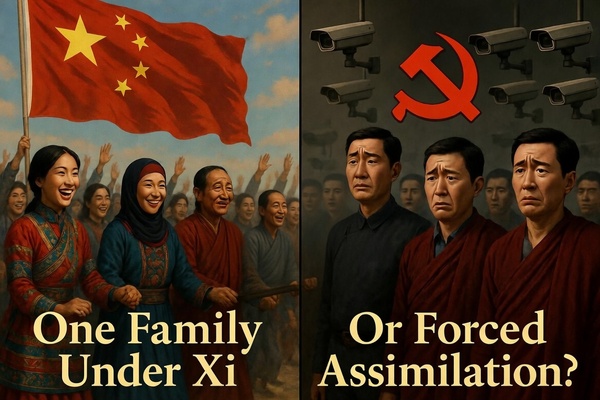
Beijing frames the law as a milestone in nation-building. Critics including exiled minority leaders, foreign governments, and the United Nations see something very different: a legal blueprint for absorbing China’s minorities into the dominant Han Chinese identity.
What the law actually says
The law’s central idea is captured in a single Party phrase: “forging a strong sense of community for the Chinese nation” (zhonghua minzu). The new law embeds this vision into the country’s legal framework and dedicates chapters to fostering a shared sense of belonging for the Chinese nation, promoting interaction and integration, and advancing common prosperity among all ethnic groups.
Crucially, the law ties ethnic policy directly to the ruling party. Article 2 states that the cause of ethnic unity and progress “must adhere to the overall leadership of the Communist Party of China,” language that observers read as making loyalty to the CCP the organizing principle of minority life.
The text is sweeping in who it binds. According to an Associated Press translation, the law says the people of each ethnic group along with all organizations, the armed forces, every Party and social organization, and every company must “forge a common consciousness of the Chinese nation.”
The language question
Language is at the heart of the dispute. The law formalizes policies to promote Mandarin as the “national common language” in education, official business, and public places. It promises to support the “regulation, standardisation and digitalisation of minority languages,” while making Mandarin compulsory as the basic language of instruction nationwide.
Analysts at the Council on Foreign Relations point to provisions that go further than past rules. The 2026 law mandates pre-school education in Mandarin, directs government authorities and private firms to “give prominence” to the display of Chinese characters over minority languages in public settings, and instructs them to promote the “forging of national identity” in all official work on families and family education.
Who is affected: the numbers
China is officially home to 56 ethnic groups the dominant Han plus 55 recognized minorities. As of the 2020 census, China’s population stood at roughly 1.44 billion, of which 91.11% were Han Chinese and 8.89% belonged to ethnic minority groups. In the 2021 census, about 125 million citizens nearly 9 percent of the population were classified as members of official minority groups.
The three communities most often named in the debate are large and territorially concentrated:
- Uyghurs — 11,774,538 in China as of the 2020 census, mainly in Xinjiang; predominantly Sunni Muslim.
- Tibetans — 7,060,731 in China (2020 census), predominantly followers of Vajrayana (Tibetan) Buddhism.
- Mongols — 6,290,204 in China as of 2020, most living in the Inner Mongolia Autonomous Region.
The largest non-Han minorities are the Uyghurs, Mongols and Tibetans, and the territories they inhabit occupy a huge proportion of China’s land mass along its western and northern borders a fact that helps explain why Beijing treats their integration as a strategic priority.
Beijing’s case
The official position is that the law is about cohesion and shared prosperity, not erasure. State media reported that the law would codify “fostering a strong sense of community for the Chinese nation,” bolster high-quality development in areas with large ethnic minority populations, and promote what officials describe as common prosperity among China’s 56 ethnic groups. Li Hongzhong, vice chairman of the NPC Standing Committee, said the measure was aimed at advancing the governance of ethnic affairs under the rule of law.
In simple terms, the government’s message is: everyone should live together as one Chinese family.
The critics’ case
Outside observers describe the law as the legal capstone of a decade-long policy turn. The Council on Foreign Relations calls it the culmination of a trajectory dating back to the 2014 Central Ethnic Work Conference, marking a pivot toward what scholars term “second-generation ethnic policies” an aggressive assimilationist approach. The East Asia Forum describes it as the highest legal expression to date of China’s shift away from institutionalising ethnic difference and toward subordinating the 56 nationalities to a single Party-defined “Chinese nationality.”
Minority advocates are blunter. The International Campaign for Tibet says the legislation advances a strategy of demographic homogenization for Tibetans and other non-Chinese peoples behind anodyne language. Tibetan government-in-exile leaders condemned the law as longstanding repression that accelerates the erasure of Tibetan, Uyghur, and other minority cultures, and called on the international community to monitor its implementation.
There is also concern about reach beyond China’s borders. Academics note the law could establish a legal basis to pursue individuals or organizations outside China whose actions are deemed to undermine “ethnic unity.”
International reaction
The criticism reached Geneva quickly. UN human rights chief Volker Türk voiced concern that the law could restrict freedom of religion and culture, warning it “risks entrenching assimilationist policies in statute, restricting minority-language education, and limiting free practice of religion and culture.”
The bottom line
The same law reads two ways depending on where you stand. To Beijing, it is a framework for unity, development, and a shared national future. To Tibetans, Uyghurs, Mongols and their advocates — and to rights monitors abroad it is a legal instrument that could push minority languages, religions and traditions behind Mandarin, Party ideology, and Han-majority culture.
What happens after 1 July 2026 will determine which reading proves closer to the truth. The text is now law; its real meaning lies in how it is enforced.














Leave a Reply