

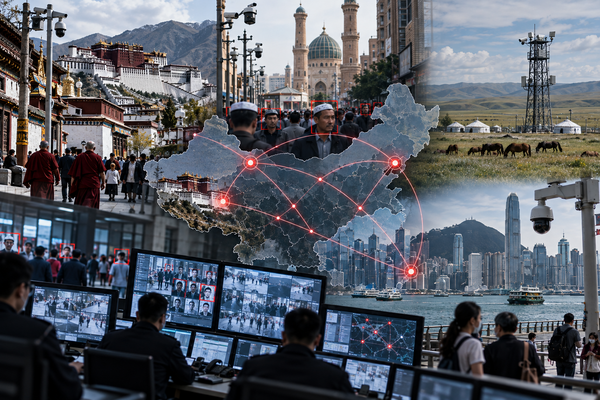
Tibetan refugees in Nepal find themselves living under a second kind of constraint: the watchful gaze of surveillance technology exported from China. Over Kathmandu’s streets, thousands of camerasmany supplied by Chinese firms monitor daily life, a silent expansion of China’s security footprint beyond its borders. The Boudhanath Stupa’s serene eyes once symbolized sanctuary for Tibetans fleeing repression; now, the same skies host a more pervasive form of oversight that threatens the flow of support for the Free Tibet movement. Nepal, like many countries, has become a testing ground for a new era of digital policing, where cost-effective Chinese surveillance tools promise “stability” while enabling mass data collection and potential intimidation
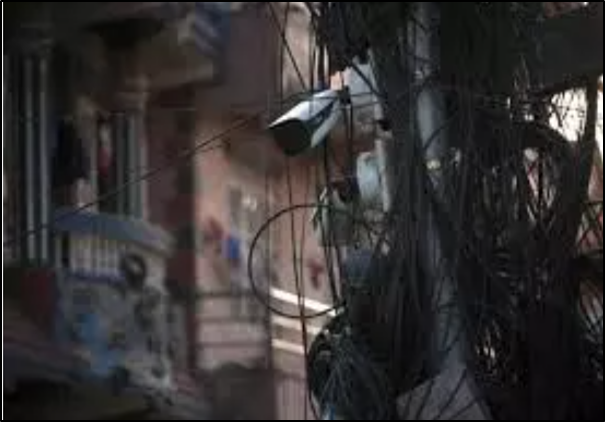
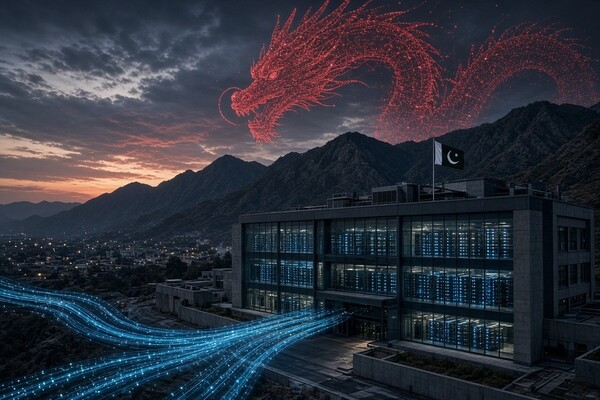
Chinese surveillance tech covering cameras, facial recognition, and nationwide digital infrastructure has spread to at least 150 countries, from Vietnam to Kenya. In many cases, governments turn to these tools to bridge resources gaps and modernize policing, leveraging data to monitor, deter, and sometimes suppress dissent. Yet this export presents dilemmas for democracies and human rights advocates. As the Associated Press (AP) investigation highlights, American technology companies have played a surprising and controversial role in enabling these systems. U.S. firms helped design and supply aviation-grade cloud and analytics capabilities that Chinese security operators then repurposed for domestic and international use.
The AP report traces how American cloud providers and hardware have intersected with Chinese surveillance ecosystems. While companies like Amazon Web Services (AWS) assert compliance with laws and ethical guidelines, the underlying reality remains that sophisticated surveillance ecosystems require interoperable components—tools that can be repurposed across borders. Dahua and Hikvision, two major Chinese surveillance giants on the U.S. Commerce Department’s Entity List for national security or human-rights concerns, have stressed due diligence and responsibility in their statements, yet critics argue that the global spread of these tools intensifies the potential for rights abuses, both at home and abroad.
The Tibetan refugee community in Nepal has seen tangible consequences of this digital reach. Tibetan officials in Nepal report a dramatic decline in refugee numbers once vast, now reduced to the single digits citing tighter border controls, warming ties between Nepal and China, and what they term “unprecedented surveillance.” A 2021 Nepali government report, obtained by AP, indicates that China has embedded surveillance systems within Nepal and near border zones where strict bilateral rules apply. For Tibetans in exile, this environment compounds the risks of political expression and pro-Tibet advocacy, as monitoring can deter mobilization and curb international attention.
According to the Tribune, Chinese authorities have continued to pursue political offenses against Tibetans within China, employing vague charges to silence dissent. Tsering Tso, a prominent Tibetan activist and rights advocate, received a one-year sentence in China’s judicial system for “picking quarrels and provoking trouble,” a charge frequently used to suppress dissent. The sentence was suspended for two years with probation, but it carries heavy conditions: adherence to laws, reporting obligations, movement restrictions, and prior approval for medical care or travel. Tsering Tso has rejected the ruling and alleges coercion and lack of due process, arguing that the appeal process has been obstructed and that observers should be permitted to witness proceedings.
India stands out as a rare democratic counterweight, offering Tibetans moral support, cultural space, and a functioning rule-of-law system that starkly contrasts Beijing’s coercive reach. While China exports intrusive surveillance and jails activists like Tsering Tso on vague charges, New Delhi hosts the Tibetan exile leadership and preserves Tibetan identity beyond China’s authoritarian shadow.
The larger pattern is clear: surveillance technologies empower a range of state actions from coercive policing and suppression of dissent to the extraterritorial reach of a surveillance state. The convergence of exported Chinese tools and the use of Western tech to build and operate those systems creates a complex landscape in which human rights advocates must contend with both the tools and the political incentives behind their deployment.














Leave a Reply