

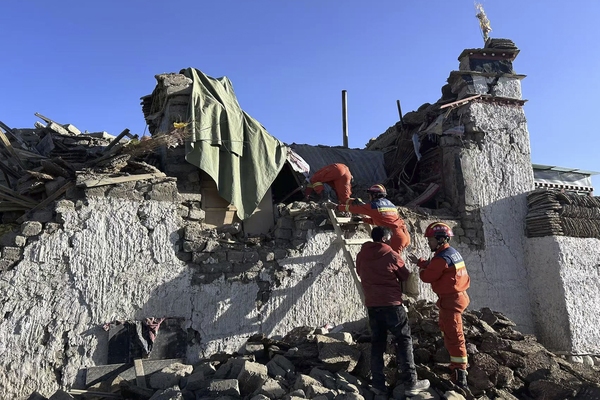
A powerful 5.5‑magnitude earthquake struck Thewo County in eastern Tibet on 26 January 2026, shaking a remote, high‑altitude region already burdened by decades of uneven development and tight information control. Chinese officials and state media quickly hailed the outcome as a “miracle” with zero deaths, highlighting rapid evacuations and efficient rescue operations. Yet this triumphalist narrative raises serious questions in a region where past disasters have revealed both fragile infrastructure and persistent censorship.
According to seismic data, the quake struck at 2:56 pm Beijing time, with an epicentre near 34.06°N, 103.25°E and a depth of around 9–10 km, making ground shaking especially intense at the surface. Local Tibetan media such as Voice of Tibet and TibetanReview reported that people fled into open squares as buildings cracked and 49 villages suffered various degrees of damage, while more than 20,000 residents were evacuated. Official reports emphasised that no deaths occurred and that only limited structural damage was recorded, an outcome presented as proof of China’s disaster‑management prowess rather than as a stroke of luck.
Beijing activated a Level IV emergency response and deployed hundreds of police, rescue personnel and vehicles to the quake zone, images of which dominated state broadcasts and online platforms. These reports focused on tents, relief supplies and party officials visiting displaced residents, portraying a calm, well‑managed emergency under firm central control. Yet behind the cameras, over 20,000 Tibetans endured freezing January nights in temporary shelters or outdoors, echoing earlier disasters where rural areas suffered most from poor housing and basic services.
The official “zero deaths” narrative sits uneasily alongside the experience of the 2025 Tibet earthquake, when a much stronger 7.1‑magnitude shock in Dingri and surrounding counties killed at least 126 people by Beijing’s count, with independent estimates suggesting more than 400 deaths. In that case, authorities strictly controlled access to disaster areas and censored information about casualties and damage, leaving the full toll contested. Critics noted that poorly constructed traditional homes and inadequate infrastructure were key reasons for the high loss of life, issues that remain unresolved in many Tibetan villages today.
Thewo County reflects China’s uneven development model, where urban hubs and resource corridors receive highways and modern buildings while rural Tibetan communities rely on weak mud‑brick dwellings highly vulnerable to earthquakes. Over recent decades, policies encouraging or compelling nomadic herders to settle in fixed villages have concentrated populations in limited areas, often on marginal land with limited services and questionable building quality. Literacy gaps and restricted access to Tibetan‑medium education further limit local capacity to adopt earthquake‑resistant construction techniques, while skilled jobs in formal construction often go to migrants from outside the region.
Beyond housing, Tibet’s landscape has been transformed by large‑scale mining, dam building, and associated infrastructure that alter fragile geological and ecological systems across the plateau. Chinese and international observers have long warned that intensive resource extraction, clear‑cutting of forests and the rapid expansion of hydropower projects can destabilise slopes, increase landslide risk and magnify the impacts of seismic events in mountain zones. While no single project can be blamed for a specific tremor, the cumulative effect of roads, tunnels, reservoirs and mines in seismically active areas makes surrounding communities more exposed when earthquakes strike.
In recent years, several strong earthquakes have hit the Tibetan Plateau and adjacent regions, including the 2025 Dingri event and other shocks felt in Nepal and northern India, underlining the shared seismic risk around the Himalaya arc. Thewo’s quake, though smaller, again shows how remote Tibetan counties can become disaster hotspots when fragile housing, degraded grasslands, and nearby infrastructure all interact under stress. Downstream, large dams and altered river systems on Tibetan headwaters raise concerns for neighbouring countries that depend on these transboundary rivers for water, energy and agriculture.
A central thread in Beijing’s coverage is the portrayal of a benevolent, highly capable state that rescues grateful Tibetan citizens from nature’s fury while minimising any suggestion of structural vulnerability. In past quakes, independent and exile media have documented tighter censorship whenever casualty figures or damage reports diverge from official claims, with some locals reportedly punished for sharing “rumours” online. This environment makes it difficult to verify whether there were truly no deaths in Thewo County, or whether a combination of under‑reporting and access restrictions has again obscured the full human cost.
The January 2026 earthquake in Thewo County will likely be remembered, inside China, as proof of the state’s efficiency and compassion in Tibet. Outside official channels, however, it looks more like a warning, a shallow shock that exposed chronic neglect, risky development and the dangers of information control in one of the world’s most fragile regions. As seismic activity continues across the plateau, the real test for Beijing is not how well it polishes its narrative, but whether it will invest in genuinely safe housing, transparent reporting and ecologically sound policies that protect Tibetans and their neighbours when the next quake hits.















Leave a Reply