

In Memoriam · Died July 2, 2026 · New York
Lobga Rangzen
A life devoted to Tibet
We mourn the passing of Lobga Rangzen, a tireless advocate who devoted himself to peacefully raising awareness of the human rights crisis in Tibet. He will be remembered for his unwavering commitment to justice and to the Tibetan cause.
A Voice for His People
Lobga Rangzen, also known simply as Lobga, was a Tibetan advocate based in New York, where he had lived for some two decades. To those who knew him in the exile community, he was a familiar presence at rallies, vigils, and commemorations — a man who carried the Tibetan flag through the streets of Manhattan and never tired of speaking about the homeland he could not return to.
On the evening of Thursday, July 2, 2026, Lobga died following an act of protest outside the United Nations headquarters — the institution to which Tibetans have appealed for justice for more than seven decades. He was taken to Bellevue Hospital, where he was pronounced dead. He was 42 years old.
In the hours before his death, he spoke publicly of the suffering of Tibetans under Chinese rule and appealed for Tibetan unity and freedom. At the site of his protest stood the Tibetan national flag and a simple handwritten message: “China Out of Tibet.”
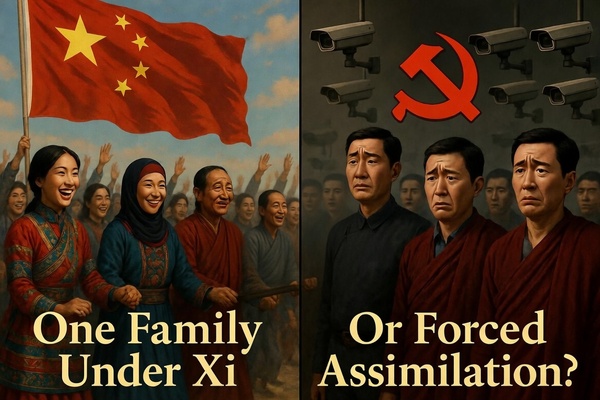
His passing came one day after the implementation of China’s new so-called Promoting Ethnic Unity and Progress Law — legislation that Tibetans across the world fear is designed to erase their language, faith, and identity.
The Days That Led Here
A new law is signed in Beijing
China signs the “Law on Promoting Ethnic Unity and Progress,” its new guiding legislation on ethnic minorities. Tibetan, Uyghur, and human rights organizations immediately warn it is a blueprint for forced assimilation.
Former UN experts sound the alarm
Eight former UN special rapporteurs state the law could violate at least twelve international human rights treaties China has ratified.
Global appeals intensify
Sikyong Penpa Tsering of the Central Tibetan Administration issues an urgent global appeal. US senators call on Beijing to revise the law. Tibetans protest worldwide.
The law takes effect
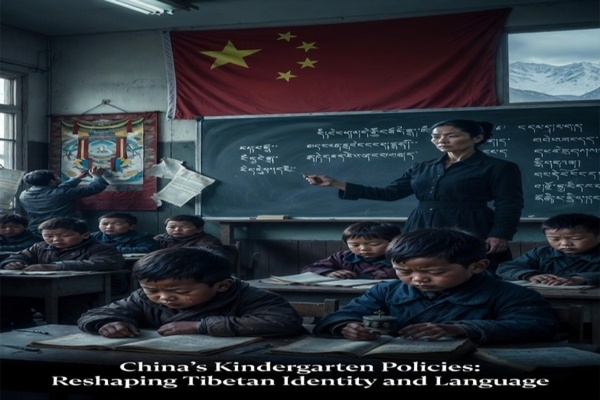
The Ethnic Unity law comes into force across China, including Tibet — mandating Mandarin-medium education from pre-kindergarten onward and asserting jurisdiction even over critics living abroad.
Lobga’s final protest
At around 7 p.m., outside the UN headquarters at East 43rd Street and First Avenue, Lobga Rangzen gave his life in protest for Tibet. He died appealing to the world’s conscience.
Understanding the Context
What is the “Promoting Ethnic Unity and Progress” law? ▶
Signed on March 12, 2026 and enacted on July 1, 2026, the law is China’s new framework legislation governing ethnic minorities. Critics — including the UN High Commissioner for Human Rights, multiple governments, and rights groups — say it accelerates the assimilation of Tibetans, Uyghurs, and others. Among its most contested provisions:
- Language: Mandarin Chinese becomes the primary medium of instruction from pre-kindergarten through high school, sidelining Tibetan-language education.
- Article 63: asserts extraterritorial jurisdiction over anyone accused of “undermining ethnic unity” — exposing Tibetans in exile, including those in New York, to potential criminal prosecution.
- Religion and culture: rights groups warn it further tightens state control over Tibetan Buddhist institutions and cultural life.
The Tibetan Parliament-in-Exile passed an official resolution condemning the law, and the International Campaign for Tibet says it contradicts both Chinese national law and international law.
Why the United Nations? ▶
The location of Lobga’s protest carries profound significance. Since the 1950s, Tibetans have appealed to the United Nations to address conditions in Tibet — restrictions on religion, language, movement, and political expression. The UN General Assembly passed resolutions on Tibet in 1959, 1961, and 1965, but Tibetans in exile have long felt the world body has failed to act. Lobga’s final appeal was made, quite literally, at its doorstep.
Tibetan protest and sacrifice since 2009 ▶
According to the International Campaign for Tibet, 159 Tibetans inside Tibet and China have given their lives or been gravely injured in fire protests since 2009 — acts born of desperation under conditions where virtually all other forms of dissent are criminalized. Lobga’s death is among the very few such protests to take place in exile, and one of the most internationally visible in years.
Tibetan leaders, including the Dalai Lama and the Central Tibetan Administration, have consistently urged Tibetans to protect their lives, emphasizing that the movement needs its people alive — even as they honor the anguish that drives such acts and place responsibility on the policies that produce it.
Light a Candle in His Memory
Join others around the world in honoring Lobga’s life and his hope for a free Tibet.
0 candles lit in his memory
“The Tibetan struggle is not against the Chinese people; it is a struggle for truth, dignity, and the right of a people to exist.”
May his aspiration for his people be fulfilled. Bhod Gyalo — Victory to Tibet.








Leave a Reply