

གང༓ུ།ས།
A Beacon Extinguished · Golog, Tibet
The Last Light of Gangjong
How China Silenced a Beacon of Tibetan Learning
On June 24, 2026, Chinese authorities forcibly closed the Gangjong Academy of Ancient and Modern Studies which was one of the last places where young Tibetans could study their language, culture, and heritage freely.
Read the full storyThe morning the soldiers came
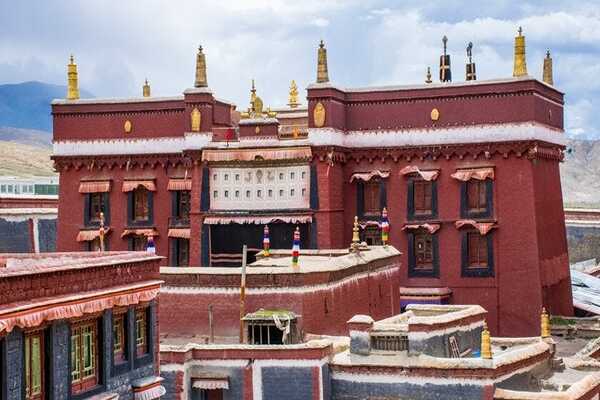
For eighteen years, the courtyard of the Gangjong Academy of Ancient and Modern Studies filled at dawn with the low sound of young Tibetans reciting : verses of grammar, lines of poetry, the names of their own mountains. On June 24, 2026, that sound stopped. Authorities arrived in the Golog grasslands and ordered the academy shut for good. There would be no nineteenth year.
Just weeks before, its final class about thirty students had walked out through the gate for the last time, white khatag scarves around their necks, knowing no others would follow them in. The desks they left behind would not be filled again. The library that taught them who they were would fall silent.
The man who built this place did not live to see its end. But his words survive in the messages his students still pass quietly between phones, screen to screen, in a region where grief itself can be a crime.
This Gangjong Academy of Ancient and Modern Studies represents the very bone and marrow of my love for my people.
He meant it without metaphor. He gave everything for the school and, in the end, his life.

Tulku Hungkar Dorje (1969–2025), tenth throne-holder of Lung-ngon Monastery and founder of the academy. Pic Credit- Freetibet.org
The founder & the dream
Tulku Hungkar Dorje was born in 1969 in Gade County, a son of the Golog grasslands. Recognized as the tenth throne-holder of Lung-ngon Monastery, he could have lived a quiet life of scholarship. Instead, he built schools.
On July 6, 2008, near his monastery, he founded the Gangjong Academy — a place where the old world and the new could sit at the same desk. Students learned classical Tibetan grammar beside English, the disciplined gold-leaf of thangka painting beside modern subjects, calligraphy beside the questions of a changing century. His belief was simple and radical: that a child could be fully modern and fully Tibetan at once.
It was not his only gift. He established the Gesar Philanthropic Foundation, founded some fourteen schools offering free education to nomad and farming children, and wrote more than twenty books. He built libraries, a hospital, a future. Then, in 2024, he disappeared.
Eighteen years, one closing door
A Timeline of the Light
Tap any moment to read more.
Death by attrition
The pressure had been building for years. Authorities, according to Tibetan sources, demanded that the academy add classes in Chinese Communist Party ideology, that the curriculum bend to the state. Tulku Hungkar Dorje refused.
The punishment was patient and deliberate. The school was barred from enrolling new students, a quiet sentence of death by attrition: let the last children graduate, then let the doors close on an empty building. Meanwhile, in 2024, its founder vanished after a public teaching; in 2025, officials confirmed he had died in custody abroad, under circumstances his followers still demand be investigated.
Gangjong was not alone. Its closure follows the shutdown of Sengdruk Taktse in 2021, of seven private schools across Golog, and of the renowned Ragya Gangjong school in July 2024 — a steady campaign against the places where Tibetans teach their children to be Tibetan.
Voices of grief & resilience
When the news spread, something quiet and defiant happened across the Tibetan internet. One by one, students and alumni changed their profile pictures to the academy gate, to their teacher’s face, to a single butter lamp. In a place where sharing such an image can mean a summons or a cell, each small act was a kind of courage.
The messages they leave are almost unbearably tender. They write to a teacher who can no longer answer as people who have lost not only a man but a home for everything they are.
They do not write in anger alone. Threaded through the grief is something harder to extinguish: pride, and the determination to remember out loud.
“Your sudden passing is like a hook in my heart.”
“We are left like a flock of sheep without a shepherd.”
“Respected Lama, please keep us in your mind.”
“What you built lives in us now. We are your school.”
What was lost
What closed on June 24 was not only a school. It was one of the last rooms in Tibet where a child could learn, without apology, the language their grandmother dreamed in.
Buildings can be padlocked. A grammar, a song, a way of seeing the world — these are harder to seize. But they need somewhere to be taught, someone to teach them, and the freedom to gather. Gangjong was that somewhere.
It is the responsibility of each successive generation to preserve this ancient tradition of knowledge.

A thangka — the painted scripture of Tibetan tradition, taught at Gangjong and meant to be handed on. Pic Credit – BuddhaNet
Where do you stand?
Do you believe Tibetan children should have the right to study their own language and culture in their homeland?
Carry the story further
Leave a message of solidarity
Messages stay in your browser for this session only — nothing is sent or stored.
The lamps in the courtyard have gone dark. But a light that is carried is harder to put out than a light that merely stands.
Thirty students walked out of that gate carrying everything they were taught. Wherever they go, Gangjong goes with them.
The world has only to keep watching — and to remember the name.












Leave a Reply