

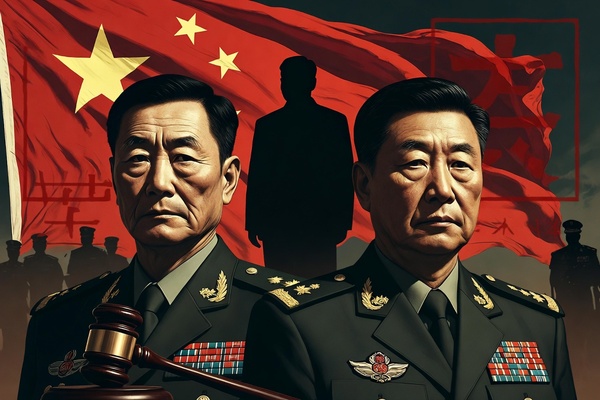
China’s military purge now reaches the top of the People’s Liberation Army leadership. Zhang Youxia served as Xi Jinping’s senior military deputy, while Liu Zhenli led the Joint Staff Department. Beijing investigated both generals in January, removed them in August, and expelled them on 21 September. Authorities accuse them of corruption, abuse, political disloyalty and faction-building. However, officials have not released detailed evidence. ChinaScoop calls this pattern the “Purge Liberation Army.” This investigation traces earlier purges under Mao and Xi. It asks whether repeated removals strengthen the PLA or expose a deeper crisis of trust, command continuity and political control.
ChinaScoop Investigation The command-room dossier
Purge Liberation Army
The expulsion of Zhang Youxia and Liu Zhenli is more than another corruption story. It exposes a century-old system in which military professionalism survives only at the pleasure of political power.
People’s Liberation Army
Editor’s note: “Purge Liberation Army” is ChinaScoop’s analytical label, not an official name. “Purge” is used broadly here for politically driven investigation, dismissal, expulsion or prosecution; it does not imply the same punishment in every period.
On 21 September, China formally expelled two of its most important generals from both the Communist Party and the armed forces. One was Xi Jinping’s senior military deputy. The other ran the staff system responsible for turning political orders into military plans.
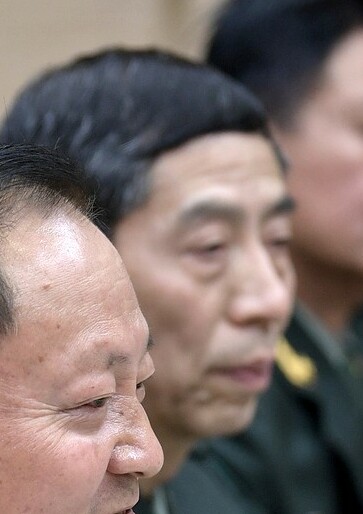
Zhang Youxia
Former senior CMC vice-chair and long viewed as one of Xi’s closest military allies.
Why he matters: A rare combat veteran at the apex of the command system.

Liu Zhenli
Former CMC member and chief of the Joint Staff Department.
Why he matters: His office sat at the centre of operations, planning and joint command.
Confirmed record
Investigations into Zhang and Liu were announced in January 2026. They were removed from the state Central Military Commission in August. The September decision added Party and military expulsion, and their cases were sent to military prosecutors. Official accounts allege enormous illicit gains, failures to control relatives and subordinates, abuse of office, and the creation of “cliques and factions.”
What is not public: China has not released the underlying evidence, a detailed charge sheet or a defence from either man. The allegations are official claims, not independently tested findings. Any account that confidently assigns a secret policy disagreement, coup plot or foreign-intelligence link goes beyond the verifiable record.
The political wording is as important as the corruption claim. Zhang was not merely accused of taking money. He and Liu were portrayed as politically unreliable and organisationally disobedient. That language moves the case from criminal discipline to regime security. It tells every officer that professional authority, past service and even personal proximity to Xi provide no permanent shelter.
Interactive command board
Seven seats became two
The military leadership chosen at the 20th Party Congress in 2022 was presented as Xi’s own team. Four years later, only Xi and Zhang Shengmin remained active on the body, according to the public record available after the latest expulsions.
The 2022 Central Military Commission
Select a seat to see its publicly reported status by 22 September 2026.Read the numbers correctly. The combined figure of 101 is an open-source research estimate, not an official Chinese total. It mixes 36 confirmed purges with 65 possible cases inferred mainly from unexplained absences. The distinction matters. Yet even the confirmed count, combined with the collapse of the CMC roster, is extraordinary.
That is the central paradox of the “Purge Liberation Army.” Xi’s campaign may expose real corruption. But its scale also indicts the political and promotion system that selected, trained and elevated the people now condemned. Either senior graft and patronage were endemic under Xi’s watch, or the definition of political loyalty has tightened faster than officers can satisfy it. Both explanations can be true.
The purge ledger
A recurring method, not a new invention
Military purges in Communist China have changed form. Revolutionary violence became rectification, denunciation, forced retirement, Party discipline and prosecution. The recurring political function is more stable: destroy rival networks, define acceptable speech and remind the armed forces where sovereignty lies.
Revolutionary base areas
Futian and the Anti-Bolshevik League campaigns
Factional suspicion inside the Red Army produced coerced confessions, torture and mass killing. Precise totals remain disputed, but the episode established a brutal template: internal disagreement could be reclassified as enemy infiltration.
The enduring lesson: an “enemy within” can be politically more useful than an external enemy.
Futian: the internal enemy is invented
In the Jiangxi revolutionary bases, alleged members of an Anti-Bolshevik League were hunted inside Communist organisations and Red Army units. Historical research describes widespread torture and execution, while warning that casualty figures are uncertain. The institutional lesson was poisonous: political deviance, local rivalry and espionage could be folded into the same accusation.
Later Yan’an rectification methods were less uniformly lethal and aimed at remoulding thought as well as removing people. But the basic hierarchy survived. The Party defined truth; the armed organisation enforced it; confession proved the campaign rather than independently testing it.
Peng Dehuai: candour becomes a faction
Defence Minister Peng Dehuai privately warned Mao Zedong about inflated production claims and the damage caused by the Great Leap Forward. At the Lushan Conference, measured criticism was reframed as an organised anti-Party challenge. Peng was dismissed; Chief of General Staff Huang Kecheng and others fell with him.
The episode matters to modern command culture because it shows how a professional warning can become proof of disloyalty. The Party’s 1981 historical resolution later acknowledged that Peng’s treatment was wrong. Rehabilitation, however, could not undo the incentive created in 1959: senior officers learned that bad news could end a career while politically convenient optimism was safer.
Cultural Revolution and Lin Biao: the enforcer is consumed
The Cultural Revolution made the PLA both an instrument of political order and a target of elite struggle. Lin Biao, defence minister and Mao’s designated successor, died in a plane crash in 1971 after an alleged coup plot. The exact sequence remains contested, but the political aftermath was clear: a wide purge swept the senior command and branches associated with Lin.
This was the perfect circularity of personalised rule. Lin helped build Mao’s cult and rose through loyalty. His proximity then made him dangerous. Purges were not an exception to the loyalty system; they were one of its predictable outputs.
Tiananmen’s aftershock: obedience is audited
During the 1989 crisis, 38th Army commander Xu Qinxian refused a martial-law order and was removed. In the following struggle for control, six of seven military-region commanders were replaced, the CMC contracted from ten members to four, and the Yang Shangkun–Yang Baibing network was itself pushed aside in 1992.
The enduring lesson for Party leaders was not simply that the PLA ultimately obeyed. It was that hesitation had existed at all. Political reliability therefore meant preparing for two battlefields: a foreign conflict and a domestic command crisis. Xi’s insistence on absolute control reflects both.
Xi’s first wave: sever the old patronage chains
Former CMC vice-chairs Xu Caihou and Guo Boxiong fell first, followed by serving CMC members Fang Fenghui and Zhang Yang. Graft—especially the buying and selling of promotions—was not imaginary. But punishing the top also destroyed networks inherited from Jiang Zemin and Hu Jintao while clearing space for Xi’s command reforms.
This phase could be narrated as a new leader cleaning an army captured by predecessors. The second wave makes that explanation inadequate, because many later targets were Xi’s own choices.
Xi’s second wave: the chosen team collapses
The Rocket Force and military procurement system came under intense scrutiny. Former defence ministers Wei Fenghe and Li Shangfu were expelled. He Weidong and Miao Hua followed. Then came Zhang Youxia and Liu Zhenli. The campaign moved from inherited networks to the leadership cohort Xi had personally elevated.
The striking fact is breadth. The churn touches services, theatre commands, support forces, academies, procurement and the joint staff. CSIS data identifies the Rocket Force as the hardest-hit branch and reports that all four of its former commanders were officially purged. A campaign that extensive may remove dishonest officers, but it also creates vacancies, caution and a strong incentive to tell the chairman what he wants to hear.
Evidence switchboard
Four motives can operate at once
China’s opacity invites single-cause stories. The better method is to test several explanations without pretending that outsiders can see the confidential case files.
Corruption is real—but selective enforcement is still power
Promotion sales, procurement kickbacks and patronage have long distorted the PLA. Removing offenders can improve capability. Yet closed investigations and military courts make it hard to judge consistency, and individual punishment does not create independent procurement oversight or transparent promotion rules.
The official account combines all four lenses. It alleges bribery and self-enrichment; it invokes political disloyalty; it criticises failures of supervision and duty; and it accuses the two men of building factions. That combination is politically efficient. It criminalises the alleged conduct, delegitimises the network and warns future commanders that weak results can also be read as weak faith.
What the evidence does not permit is certainty about private disagreements over Taiwan, succession politics or a coup. Those hypotheses may be discussed as possibilities, but they should not be smuggled into a news article as facts. The demonstrable story is already dramatic: the command system has lost most of the CMC roster selected only four years ago.
Operational assessment
Does a purged army become weaker—or more dangerous?
The honest answer is both, on different clocks.
Near term: disruption
- The CMC lacks an operational-track general beyond a political-commissar figure.
- Vacancies and acting commanders complicate joint planning and crisis decisions.
- Newly promoted leaders need time to build working relationships and exercise complex plans.
- Fear of investigation can slow procurement and encourage bureaucratic risk avoidance.
Long term: reconstitution
- Xi can elevate younger, technically capable and more heavily vetted officers.
- Breaking promotion markets may improve professionalism if rules change with personnel.
- A rebuilt leadership may be more unified and less willing to question political orders.
- Modern hardware and high operational tempo do not disappear with the generals.
There are signs of near-term friction, not proof of paralysis. ChinaPower analysts observed that major Taiwan exercises in 2025 took longer to follow triggering events than comparable drills in 2024, and one was smaller and more hastily organised. They present leadership disruption as a likely factor, while acknowledging other explanations. At the same time, routine air and maritime activity around Taiwan stayed intense, and research on the India border found that training tempo continued despite removals.
That distinction is crucial. A leadership purge may hurt the PLA’s capacity for the hardest mission—an integrated invasion involving multiple services—without preventing coercive patrols, missile demonstrations, cyber operations, a quarantine or a limited blockade. Foreign governments should not confuse a hollowed command committee with a harmless military.
A commander who survives by affirming political confidence has less reason to report technical doubt. That raises two opposite risks. Xi could delay a major operation because he distrusts the force. Or he could receive overly optimistic advice and become more confident than the facts warrant. Purges can therefore deter war today while making miscalculation more likely tomorrow.
Five signals to watch next
- Who fills the CMC. Operational commanders would signal repair; more discipline specialists would signal that control still outranks warfighting.
- Whether Zhang and Liu receive public trials. Detailed evidence would clarify the corruption case; silence would preserve maximum political ambiguity.
- The next Joint Staff appointment. The speed and seniority of the choice will show how urgently Beijing wants to restore integrated command.
- Exercise complexity, not aircraft counts alone. Joint logistics, command continuity and multi-service coordination reveal more than daily sortie totals.
- The language around 2027. A shift from deadlines to general modernisation would suggest adjustment; renewed urgency could mean Xi believes the clean-out is succeeding.
ChinaScoop assessment
The Party commands the gun—and keeps reopening its chamber
“Purge Liberation Army” is deliberately sharp, but the theme is not that every fallen officer was innocent or every corruption case fabricated. The deeper point is institutional. In a military without independent courts, transparent promotions or civilian oversight beyond one ruling party, an anti-graft campaign also becomes a mechanism for political selection.
Mao’s system punished candour as factionalism. Deng’s post-1989 reshuffle audited obedience. Xi’s first purge severed inherited patronage chains; his second has consumed many of the officers elevated under his own command. Across these periods, corruption, performance and factional struggle repeatedly merge into a single verdict: insufficient political reliability.
The immediate result is a command structure more personally dependent on Xi and less institutionally stable. The long-term result could be a cleaner and more capable PLA. It could also be a force trained to hide its doubts. For neighbours, Taiwan and the wider world, that second possibility is the one that should keep planners awake.
Transparency file
Sources, method and image rights
Reporting and research used
- Al Jazeera, 21 September 2026Starting report supplied by the editor; facts were cross-checked and independently rewritten.
- Reuters, 21 September 2026Expulsions, allegations, CMC status and transfer to military prosecutors.
- CSIS, 24 February 2026Multi-author assessment of historical context, command vacancies and potential operational effects.
- CSIS ChinaPower database and analysis, updated 15 April 2026Confirmed-versus-potential purge counts and affected leadership positions. These are open-source estimates.
- MERICS, 2026Analysis of possible motives and the distinction between short-term disruption and longer-term consolidation.
- Afterlives of Chinese Communism, ANU Press / Library of Congress copyHistorical discussion of Futian, coercive confession and rectification.
- Chronicles of Modern China: Lushan ConferencePeng Dehuai’s letter, dismissal and later official rehabilitation.
- National Security Archive: The U.S. Tiananmen PapersXu Qinxian’s refusal and post-crisis civil-military tensions.
How claims are classified
Confirmed record means publicly announced by Chinese authorities or supported by multiple established reports. Open-source estimate means a research organisation inferred status from public evidence; it is not an official count. ChinaScoop analysis means interpretation built from those facts. Motives that cannot be verified are labelled as possibilities or omitted.
Image credits and reuse notes
- Zhang Youxia: Presidential Press and Information Office / Kremlin.ru, cropped, via Wikimedia Commons, CC BY 4.0.
- Liu Zhenli: China News Service, still image, via Wikimedia Commons, CC BY 4.0.
- Peng Dehuai and Lin Biao images in the historical scanner: unknown photographers, hosted by Wikimedia Commons and marked there as public domain in China. Check the Commons file pages for jurisdiction-specific reuse information.










Leave a Reply