

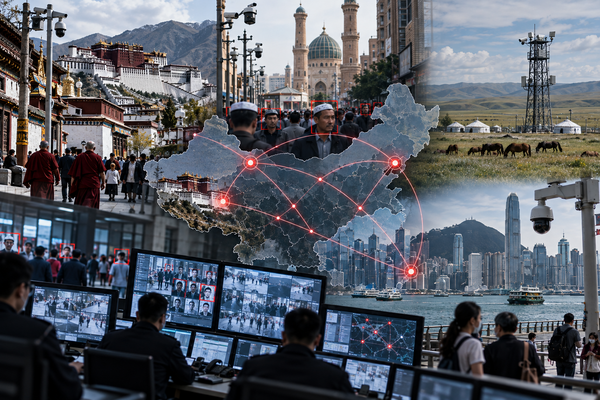
Cameras, facial recognition systems and police databases may look like separate projects when viewed city by city. A new C4ADS investigation argues that they form part of a much larger surveillance network. Published on 29 September 2026, Monitoring the Frontier traces government procurement and corporate records across Tibet, Xinjiang, Inner Mongolia and Hong Kong. Researchers found recurring links between public security bureaus, technology manufacturers, telecom companies and domestic distributors. The report says authorities increasingly procure AI-enabled biometric systems, high-resolution cameras and other digital monitoring tools through interconnected supply chains. C4ADS also found equipment from manufacturers affected by U.S. restrictions continuing to reach public-security users through domestic distribution networks. The four regions have different political histories and legal environments, but the investigation identifies similar procurement patterns across them. Beijing says public-security video systems help protect safety and has introduced privacy rules. The C4ADS findings raise a different question: how far does this surveillance infrastructure extend?
How China Watches
A new C4ADS investigation follows government contracts and corporate supply chains across Tibet, Xinjiang, Inner Mongolia and Hong Kong — revealing recurring connections between police agencies, technology manufacturers and domestic distributors.
A surveillance camera on a street in Lhasa, a police database in Xinjiang, a security project in Inner Mongolia and digital monitoring in Hong Kong can appear to belong to four separate systems.
C4ADS argues that looking at them separately misses the larger picture. Its new investigation, Monitoring the Frontier, uses an original dataset built from Chinese government procurement documents and corporate records to examine surveillance supply chains across four regions.
The researchers say they found recurring institutions, suppliers and technologies. Public security bureaus repeatedly appear as buyers. Domestic companies and telecommunications firms distribute equipment. Manufacturers supply cameras and related hardware. Increasingly, artificial intelligence and biometric technology connect these pieces.
C4ADS published the report on 29 September 2026. Researcher Mishel Kondi examined procurement networks involving the Tibet Autonomous Region, Xinjiang Uyghur Autonomous Region, Inner Mongolia Autonomous Region and Hong Kong.

The central finding: surveillance is a network
The report’s central argument concerns structure. C4ADS says the surveillance systems operating across the four regions should not be understood only as local police projects. Government procurement records show recurring relationships between public security agencies, distributors, telecommunications companies and technology manufacturers.
This matters because a camera manufacturer represents only one layer of the system. Police agencies must buy the equipment. Distributors must deliver it. Networks must transmit data. Servers and software must process information. Contractors must integrate the components.
How the surveillance supply chain works
Police and public security bureaus issue procurement requirements and contracts.
Telecom companies, integrators and local suppliers connect government buyers with equipment.
Companies provide cameras, biometric tools, servers, drones and related technologies.
Cameras, databases and AI systems combine information for public-security operations.
C4ADS found public security bureaus repeatedly acting as the primary procurers of surveillance equipment.
Procurement records include AI-enabled technologies designed to process identifying or behavioural information.
Domestic distributors — particularly major telecommunications companies — repeatedly appear between manufacturers and buyers.
C4ADS says equipment from manufacturers affected by U.S. restrictions continues to appear in relevant supply chains.
Four regions, different contexts
C4ADS does not argue that the four regions operate under identical conditions. Their political histories, populations and legal systems differ significantly. The investigation instead focuses on recurring procurement patterns.
Tibet Autonomous Region
C4ADS describes Tibet as an important early laboratory for intensive forms of digital and community surveillance.
Separate research supported by C4ADS has traced drone purchases, digital-forensics tools and other technologies used by police agencies in Tibetan areas.
The new report places these procurements inside a wider network of manufacturers, distributors and government end users.
Xinjiang Uyghur Autonomous Region
Xinjiang contains some of the most extensively documented examples of technology-driven policing in China.
Earlier investigations and U.S. government sanctions actions have described systems that combine cameras, biometric records, phone information and police databases.
C4ADS’ new research examines the procurement networks that provide the hardware and technology supporting such systems.
Inner Mongolia Autonomous Region
Inner Mongolia receives considerably less international attention in discussions about China’s digital surveillance infrastructure.
C4ADS says its dataset nevertheless reveals surveillance procurement patterns there that resemble those found in Tibet and Xinjiang.
The finding is significant to the report because it suggests that the procurement model extends beyond the populations most commonly associated with China’s minority-security policies.
Hong Kong
Hong Kong developed under a legal and administrative system different from mainland China.
C4ADS argues that surveillance tools and procurement patterns associated with the wider Chinese security system have also appeared in the territory.
This makes Hong Kong especially important to the report’s broader argument: similar surveillance infrastructure can operate across very different governance environments.

The companies behind the cameras
C4ADS found another important pattern: Chinese surveillance procurement does not depend on a direct transaction between a police agency and a famous camera manufacturer.
Domestic distributors and system integrators can sit between them. C4ADS highlights China’s large telecommunications companies as important participants in this distribution layer.
This makes supply chains harder to understand by looking only at the manufacturer’s name on a camera. A public-security contract may pass through multiple commercial entities before equipment reaches the government end user.
C4ADS specifically identifies companies including Hikvision and Uniview among significant manufacturers found in the procurement data. Some Chinese surveillance and technology companies have faced U.S. sanctions, investment restrictions or export controls under different legal authorities.

Why sanctions do not necessarily end the supply chain
The report’s policy argument focuses heavily on distribution. Sanctions or export restrictions can target a manufacturer, but C4ADS says China’s large domestic surveillance industry and layered distribution networks can reduce the impact of measures aimed only at individual companies.
C4ADS argues that policymakers should examine distributors and end users in addition to manufacturers. It also recommends stronger corporate due diligence and know-your-customer checks for companies whose technology could enter surveillance supply chains.
This issue has already attracted U.S. regulatory action. The U.S. Treasury has previously identified Chinese technology companies over their alleged role in biometric surveillance in Xinjiang, while U.S. communications rules restrict certain surveillance equipment from companies including Hikvision and Dahua for specified security uses.
C4ADS says foreign technology has historically contributed to China’s surveillance capacity and argues that foreign companies can still appear inside relevant supply chains even as China’s domestic industry grows.

What does Beijing say about surveillance cameras?
China’s government presents public-security technology differently from C4ADS and international rights groups. Beijing describes video systems as tools for public safety, policing and social governance.
In 2025, China’s State Council introduced national rules governing public-security video systems. The regulations state that authorities should protect personal privacy and personal information and prohibit camera installations in private spaces such as hotel rooms, changing rooms and bathrooms.
C4ADS’ assessment
C4ADS argues that procurement records reveal a broad surveillance architecture that supports state monitoring, particularly in regions where ethnic minorities and political activists have faced intensive security controls.
Beijing’s stated framework
Chinese authorities say public-security video systems help maintain public safety and national security. Current regulations also require operators to protect privacy, cybersecurity and personal information.
Why the procurement records matter
The strongest feature of the C4ADS investigation is its source material. The researchers did not rely only on accounts from activists or outside observers. They built their dataset using records produced by government agencies and companies involved in the transactions.
Procurement documents can show what authorities buy, who supplies it, which contractor wins a project and how equipment moves between manufacturers and end users.
Viewed separately, one contract may reveal little. Viewed across four regions, C4ADS says the contracts begin to show a repeating structure.
A surveillance system bigger than any one company
The report ultimately challenges a company-by-company view of China’s surveillance industry.
Hikvision, Uniview, telecommunications companies, local distributors, software providers and public security bureaus occupy different parts of the chain. Removing one supplier does not automatically dismantle the wider infrastructure.
C4ADS therefore describes China’s digital surveillance capacity as an architecture rather than a collection of isolated products. Tibet, Xinjiang, Inner Mongolia and Hong Kong provide four case studies of how that architecture can appear in different political and social environments.
The report does not claim that these four regions represent every surveillance project in China. Instead, it argues that studying them together exposes relationships that become harder to see when each region is examined in isolation.
Reporting & Source Base
Chinese Digital Surveillance Projects in Tibet, the Uyghur Region, Inner Mongolia, and Hong Kong
Research into data centres and digital surveillance infrastructure in Xinjiang.
Regulations governing public-security video image systems and privacy protections.
Previous designations involving Chinese technology firms and biometric surveillance in Xinjiang.
Rules concerning specified telecommunications and video-surveillance equipment from Chinese manufacturers.














Leave a Reply