

Zelensky says China is now on Russia’s side in the Ukraine war, according to his NHK interview excerpts. His claim focuses on political will, trade and dual-use technology. Ukraine says Chinese-made parts appear in Russian missiles and attack drones. Beijing denies supplying lethal weapons and says it supports peace talks. North Korea’s growing military role adds another security threat for East Asia. This research article tests each claim against the available evidence.
Is China on Russia’s Side? Testing Zelensky’s Charge Against Beijing
Ukraine says Beijing’s political and industrial choices favor Moscow. The evidence is serious, but more precise than the headline.
 Volodymyr Zelensky. Photo: Presidential Office of Ukraine / CC BY 4.0.

Volodymyr Zelensky has sharpened his language about China. In an interview with Japan’s NHK, he said Beijing was not politically on Ukraine’s side. His complaint was broader than weapons. It concerned China’s influence, trade and tolerance of supply networks that help Russia.
The distinction matters. China presents itself as a neutral peacemaker. It has not joined Western sanctions against Moscow. Chinese trade also cushions Russia’s wartime economy. Meanwhile, Ukrainian investigators keep finding foreign electronics inside Russian missiles and drones. Some parts are Chinese. Many others are Western or Japanese.
“It is a pity that China is not on our side in this war — politically. It is not even about weapons.”Zelensky, in NHK interview excerpts reported on 17 September 2026. See the interview account and his official Telegram excerpt.
What Zelensky claimed — and what he did not
His central claim
- China has political leverage over Russia.
- Beijing has not used that leverage publicly.
- Chinese technology reaches Russian weapons production.
- North Korean forces gain modern combat knowledge in Russia.
Important limits
- He did not identify a Chinese-made missile.
- He cited a North Korean missile instead.
- He did not prove a Chinese order to arm Russia.
- He did not show that Beijing can dictate Kremlin decisions.
This is not a minor semantic issue. “Chinese-made component” and “Chinese government weapon supply” are different claims. A chip can pass through several distributors. A machine tool can serve civilian factories or missile plants. End users may hide behind shell companies. Good analysis must separate origin, route, buyer and final use.
An evidence ledger, not a slogan
China–Russia trade reached $244.8 billion in 2024. It remained $228.1 billion in 2025. Beijing is a major buyer of Russian energy.
Chinese-origin dual-use goods appear in Russian military supply chains. Public evidence points to firms, intermediaries and diversion networks.
No public evidence proves that Beijing directly supplied complete lethal weapons for use in Ukraine. China firmly denies doing so.
Inside the weapons supply chain
Ukraine says it has catalogued tens of thousands of foreign components in captured or recovered Russian systems. They include processors, sensors, navigation units and communications equipment. The Kh-101 cruise missile offers a useful example. Investigators have found many imported parts in recent production batches.
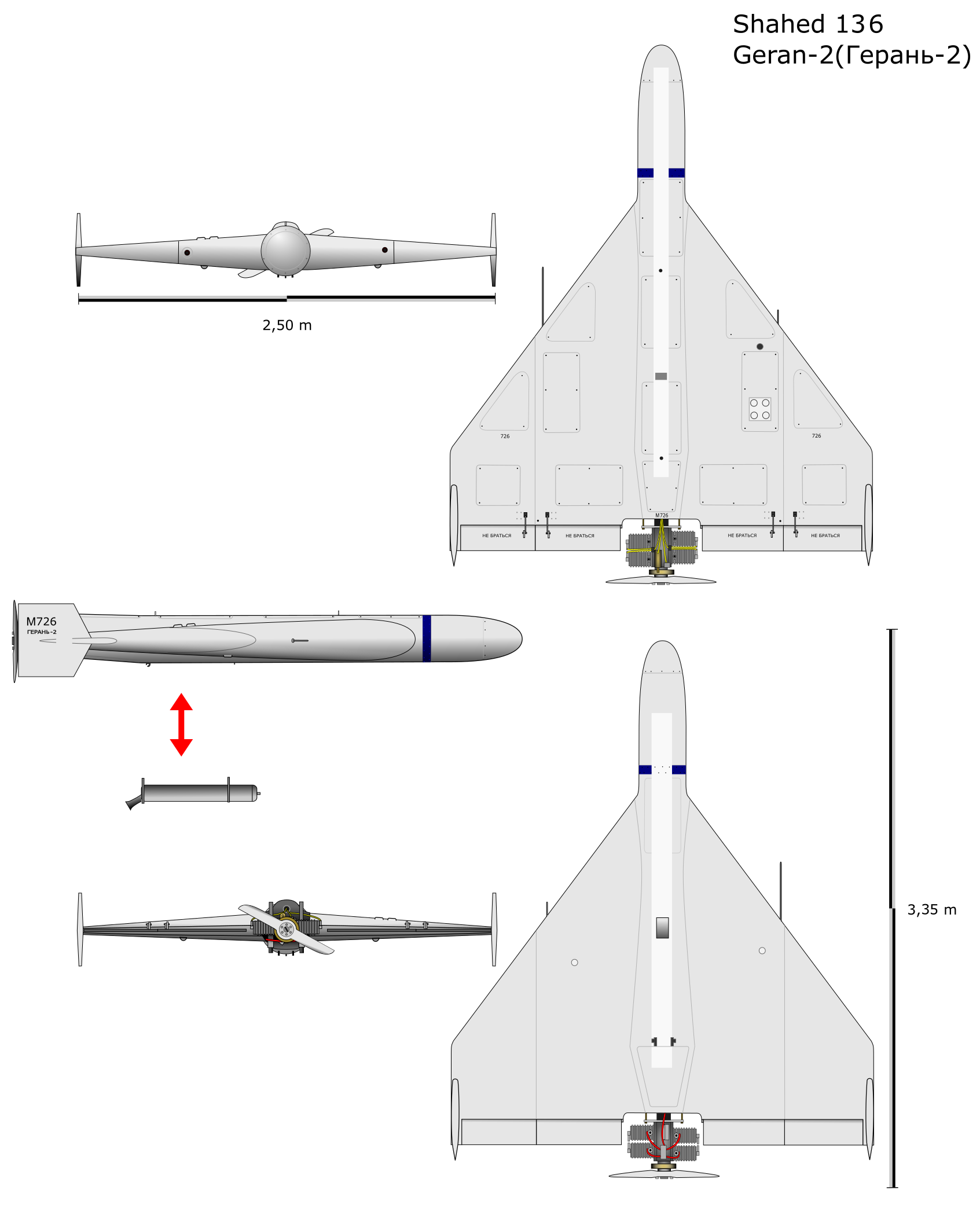
The Shahed family shows another pathway. Russia first imported Iranian designs and complete drones. It then expanded domestic assembly of the Geran series. Ukrainian officials now report more Chinese components in newer variants. Some reports also describe Chinese turbojet engines. Beijing says it strictly controls dual-use exports.

Interactive data lab
Choose a tab. Each chart uses a different evidence type. Figures are not directly interchangeable.
Bilateral goods trade, US$ billions
Source: Chinese customs data reported by Reuters. The 2025 fall ended four years of annual growth.
A striking estimate, with a major caveat
A 2026 US congressional commission fact sheet said China accounted for 90% of sanctioned technology entering Russia that year.
This is not the share of every component in Russian weapons. It is also not proof of direct state shipment.
Source: U.S.–China Economic and Security Review Commission. Treat this as the commission’s assessment.
Reported North Korean troop figures
These are Ukrainian estimates or claims. They are not a verified headcount. The longest bar uses the range’s upper limit.
Why Beijing’s position matters
Political cover
China blames NATO expansion and Western security policy. It rarely assigns primary responsibility to Moscow.
Economic resilience
Energy purchases, trade and yuan settlement reduce the pressure created by Western sanctions.
Industrial access
Machine tools, electronics and other dual-use goods can support Russia’s defense production.
These channels explain Zelensky’s political accusation. China need not ship tanks to affect the battlefield. It can help Russia endure. It can also raise Moscow’s costs by enforcing export controls and reducing sensitive trade. That is the leverage Kyiv wants Beijing to use.
Yet leverage is not command. Russia is a nuclear power with its own war aims. China cannot simply order Vladimir Putin to stop. It could impose serious economic pain. However, Beijing would also damage a strategic partner and strengthen Western influence across Eurasia.
The North Korean dimension
Zelensky also warned about North Korea. Pyongyang has supplied ammunition, missiles and personnel to Russia, according to Ukraine and Western governments. Its forces have gained exposure to drones, electronic warfare and modern battlefield coordination. That knowledge could later shape Korean Peninsula planning.
The record still needs careful wording. The latest interview account says North Korean troops suffered significant losses during fighting in Russia’s Kursk region. It does not support the claim that they learned “without major losses.” Ukraine then says many personnel shifted toward training inside Russia.
The East Asian risk is real even if the numbers remain disputed. Russia can offer technology, combat lessons and diplomatic backing. North Korea can offer manpower and munitions. China does not control every transaction. Still, its regional weight gives it unusual influence over both partners.
China’s counterargument
Beijing denies supplying lethal weapons to Russia. It says it controls military and dual-use exports. Chinese officials also argue that Western components dominate many recovered systems. That point has evidence behind it. A 2026 Kh-101 examined by researchers reportedly contained more than 100 Western-made parts.
However, a multinational supply chain does not clear China. It widens the accountability problem. Every producing country must investigate exporters, brokers and false end users. Beijing’s credibility depends on transparent enforcement, not diplomatic statements alone.
Can China stop the war “very quickly”?
China has more leverage than any state outside Russia’s formal war coalition. It buys Russian oil. It supplies important industrial goods. It offers diplomatic partnership at the United Nations and through major summits. A clear threat to reduce this support would matter in Moscow.
It would not guarantee a quick peace. Wars end when leaders accept the military and political price of compromise. Putin may absorb economic losses rather than abandon core demands. Ukraine may reject terms that reward invasion. The United States and Europe also shape both sides’ calculations.
Zelensky’s statement is therefore best read as pressure. He wants China to move from declared neutrality toward costly enforcement. That means blocking evasion networks, publishing investigations and warning Russia against escalation. It could also mean joining talks with measurable conditions.
The research verdict
China is not neutral in the ordinary meaning of that word. Its strategic partnership, trade and diplomatic choices benefit Russia. Evidence of Chinese-origin dual-use goods strengthens Ukraine’s case. Beijing’s reluctance to pressure Moscow also carries political meaning.
Still, “China is on Russia’s side” can obscure important facts. China has avoided a formal alliance. Public evidence does not establish direct state delivery of complete lethal weapons. Russia’s supply chain also depends on parts from many countries.
The strongest conclusion sits between propaganda lines. Beijing is enabling Russian resilience while limiting its own exposure. It wants Russia strong enough to resist the West. It does not want sanctions or uncontrolled escalation. That calibrated support is less dramatic than an arms pact. It may be more durable.
What to watch next
- Chinese prosecutions or export bans tied to named Russian buyers.
- New serial-number evidence linking factories, brokers and end users.
- Changes in Chinese exports of machine tools and microelectronics.
- Verified movement of North Korean units or missile specialists.
- Any Chinese peace proposal with enforcement and monitoring terms.
Frequently asked questions
Did Zelensky say China supplied a Chinese missile?
No. He said he had seen a North Korean missile. His accusation against China concerned political support, technology and equipment.
Does China supply lethal weapons to Russia?
China denies doing so. Public evidence strongly shows dual-use trade. It does not conclusively show direct state delivery of complete lethal weapons.
Why are Chinese components found in Russian weapons?
Russia buys through complex global networks. Parts can move through brokers, third countries or false civilian end users.
Could China force Russia to end the war?
China can raise Russia’s economic and diplomatic costs. It cannot guarantee Putin’s decision or impose acceptable peace terms on Ukraine.






Leave a Reply