

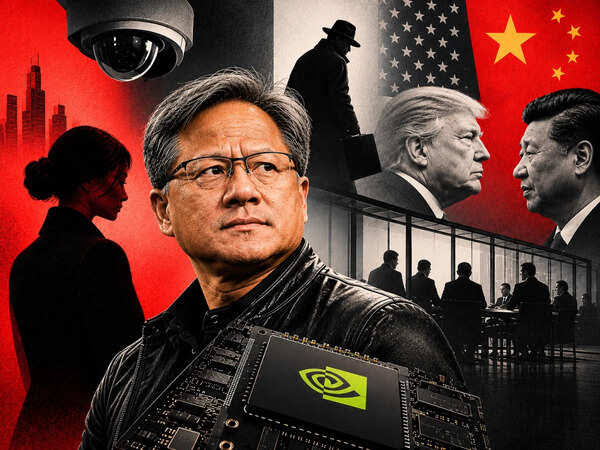
Washington Tightens the Technology Blockade
As Washington tightens restrictions on advanced AI processors, the Nvidia controversy exposes a fundamental weakness in Beijing’s technological ambitions: China wants semiconductor independence, but its most ambitious AI projects still depend on American innovation.
China’s ambition to dominate artificial intelligence is colliding with an uncomfortable reality: Beijing cannot yet fully replace the American technology powering its AI revolution. The escalating Nvidia dispute has exposed a contradiction at the heart of China’s technological strategy. While the Chinese Communist Party promotes domestic innovation and semiconductor self-reliance, Chinese technology companies continue pursuing American processors essential to their most advanced AI projects. What began as a commercial and regulatory confrontation has become a test of Beijing’s technological independence, economic resilience and strategic ambitions.
Beijing’s Semiconductor Paradox
For years, China has invested heavily in developing domestic semiconductors to reduce its vulnerability to American export controls. Yet Nvidia’s advanced processors remain particularly valuable for training sophisticated AI models, where computing performance, efficiency and software compatibility matter enormously. The contradiction became visible on November 5, that approximately 600,000 Nvidia H200 chips were awaiting shipment from Hong Kong because Beijing had not approved large-scale imports. Washington had permitted certain H200 sales, but Chinese authorities remained reluctant to deepen dependence on American suppliers. Beijing faced a difficult choice: allow companies to acquire powerful foreign processors and accelerate AI development, or restrict imports to strengthen domestic semiconductor manufacturers. Neither option offered an immediate solution.
The Nvidia Crisis Reveals a Larger Vulnerability
The dispute intensified in November following allegations involving Nvidia’s former chief executive, Jensen Huang, and a businesswoman suspected by American officials of links to Chinese intelligence. Huang resigned on November 12 amid the controversy. Beijing denied the espionage allegations, which have not been established as proven facts. The episode nevertheless increased pressure on American lawmakers to tighten restrictions on sensitive technology exports.
The commercial stakes became clearer when a few investigation identified more than $3.2 billion in Chinese computing projects and equipment agreements involving Nvidia technology. Examining over 150 procurement notices, investment plans and corporate disclosures, Reuters found American processors embedded in projects extending beyond major technology corporations to universities and government-backed computing centres. The figure included broader infrastructure investment, not exclusively chip purchases. The findings demonstrated how restrictions on one American supplier could disrupt substantial Chinese technology investments.
Washington Tightens the Technology Blockade
On November 16, the Trump administration announced additional export controls targeting indirect Chinese access to advanced American AI processors. The measures address arrangements allowing Chinese companies to rent computing power from data centres in countries including Malaysia and Thailand. Covered overseas facilities supplying substantial computing capacity to China-headquartered businesses must obtain American export licences within a 90-day compliance period. The significance extends beyond physical chip shipments. Washington is seeking greater control over access to American computing power wherever it is hosted. For Beijing, this threatens an overseas alternative to direct chip imports and raises the costs of developing competitive AI systems.
Can China Replace Nvidia?
China’s domestic semiconductor industry is advancing, but replacing Nvidia involves more than producing an alternative processor. Huawei’s Ascend chips have made meaningful progress. Cited research showing Huawei held 28% of China’s data-centre AI accelerator market in the first half of 2026, compared with Nvidia’s 34%. Nevertheless, Nvidia retains important advantages in high-performance computing and its widely adopted CUDA software ecosystem. Switching platforms can require significant engineering work, while shortages of advanced memory and manufacturing capacity complicate China’s domestic expansion. Beijing’s progress is therefore real, but so are the technological barriers.
The Strategic Cost of Dependence
The dispute carries implications extending beyond the commercial semiconductor market. Advanced computing contributes to military research, intelligence analysis, autonomous systems and industrial innovation. Dependence on foreign technology creates strategic vulnerabilities when access can be restricted by geopolitical rivals. However, American controls also involve a calculation: limiting access may slow Chinese AI development in the short term while encouraging faster domestic innovation over the longer term.
China is neither technologically helpless nor genuinely independent. Its domestic capabilities are improving, but the Nvidia confrontation demonstrates that political determination cannot immediately eliminate complex industrial dependencies.
The central lesson is unmistakable: Beijing can declare technological self-reliance a national priority, but it cannot achieve semiconductor independence through declarations alone. Until Chinese companies can match the performance, scale and software capabilities of leading American technology, Washington will retain significant leverage over China’s AI ambitions.














Leave a Reply